
Introduction
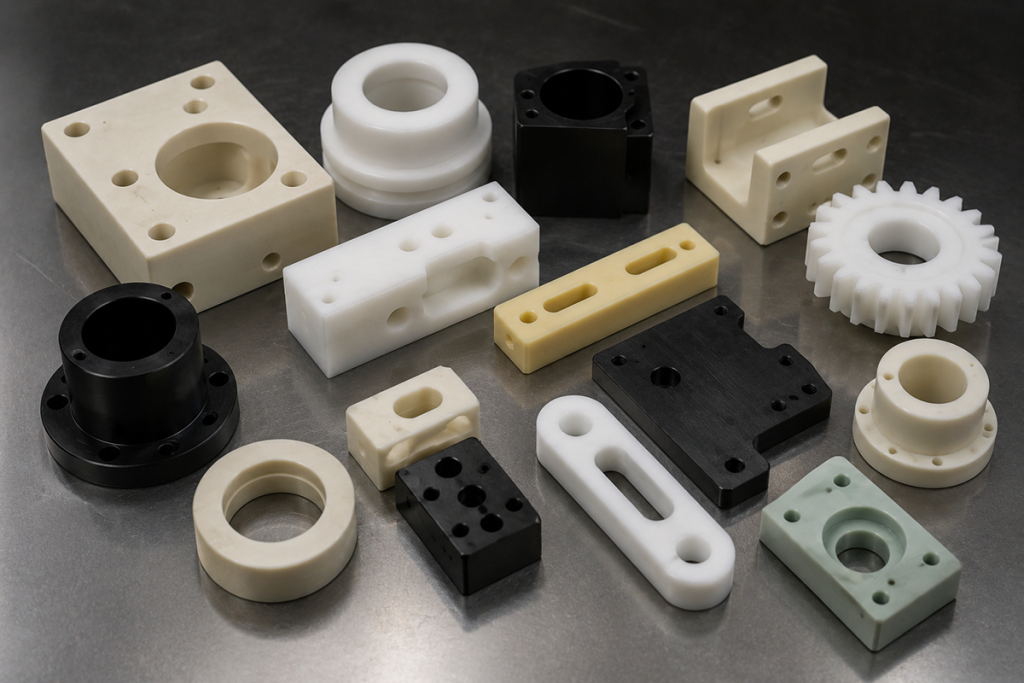
Plastic CNC machining is a practical manufacturing option when a project requires custom plastic parts without the cost, time, or design commitment of injection molding. Instead of creating a mold, CNC machining removes material from plastic sheet, rod, or block stock to produce functional components with accurate features, holes, pockets, slots, threads, and mating surfaces.
For buyers in North America, Europe, and other overseas markets sourcing custom plastic machined parts, CNC machining is often used during prototyping, low-volume production, design validation, fixture development, and functional testing. It allows engineers to test real engineering plastics before committing to mold tooling or large-volume production. This makes it especially useful when the design is still changing or the required quantity does not justify injection molding.
Plastic parts are not only cheaper alternatives to metal parts. Engineering plastics can offer low weight, electrical insulation, low friction, chemical resistance, impact resistance, reduced noise, and non-metallic performance. Materials such as POM, Delrin, nylon, PTFE, PEEK, ABS, polycarbonate, and UHMW-PE are selected for specific functional reasons.
This guide explains when plastic CNC machining works, why buyers choose it, which engineering plastics are commonly used, how it compares with injection molding, what affects precision and cost, and what information buyers should prepare before requesting a quote. If your project requires prototype plastic parts, low-volume production, wear-resistant guides, bushings, insulators, covers, or custom plastic fixtures, experienced custom CNC machining services can help confirm whether CNC machining is the right process for your design.
What Is Plastic CNC Machining?
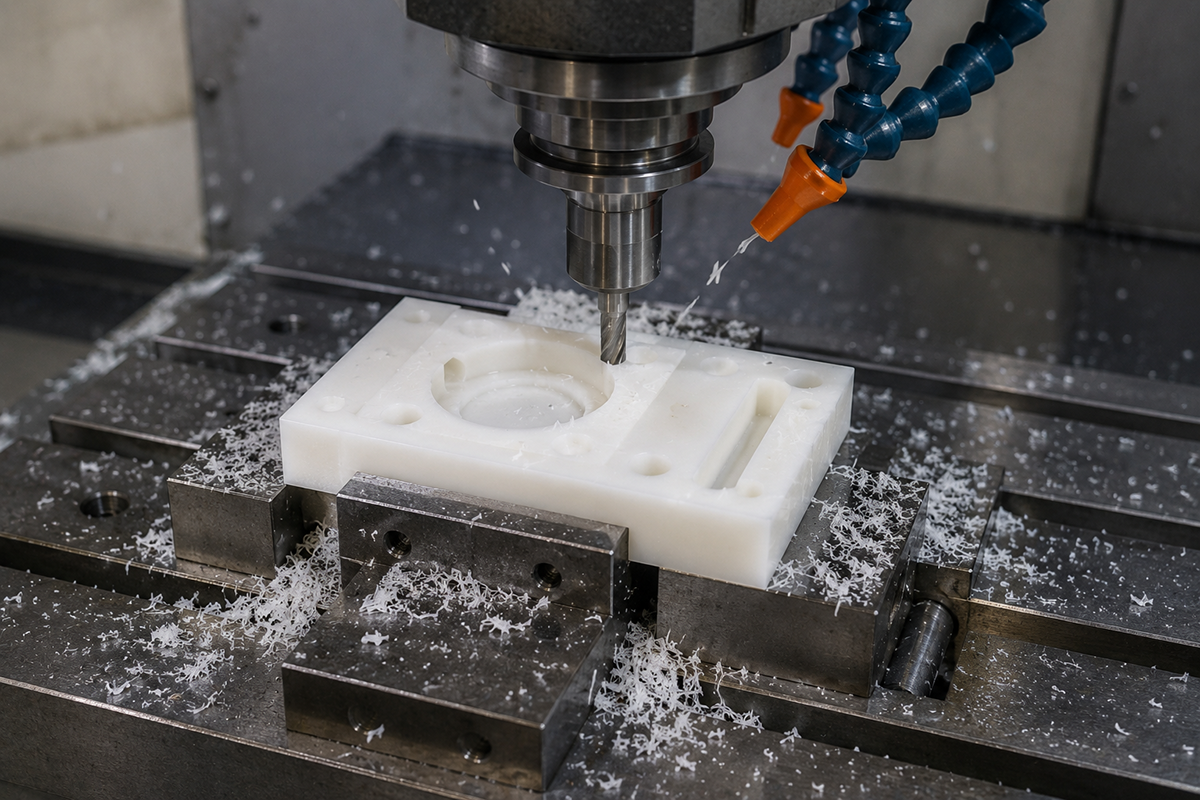
Plastic CNC machining is a subtractive manufacturing process. A CNC mill, CNC lathe, or machining center cuts material from engineering plastic stock until the final shape matches the CAD model and drawing. The process can include milling, turning, drilling, boring, tapping, contouring, pocketing, and finishing operations.
Unlike injection molding, CNC machining does not require a mold. This makes it useful when the buyer needs a small number of parts, a functional prototype, or a design that may still change. It also allows the part to be made from real engineering plastic stock, which can be important for fit testing, mechanical testing, friction testing, electrical insulation, or chemical exposure review.
CNC machined plastic parts are often used when standard plastic products cannot meet the required geometry, tolerance, or function. Instead of adapting a design around a stock part, engineers can produce custom guides, rollers, spacers, blocks, covers, housings, test fixtures, and functional components from the most suitable plastic material.
When Plastic CNC Machining Works Best
Plastic CNC machining works best when the project requires design flexibility, relatively fast delivery, and real functional parts without mold tooling. It is especially useful for prototypes and low-volume production because buyers can revise the design without paying for new injection molds.
This process is a strong choice when the design is still being tested. Engineers may need to check assembly fit, verify mounting holes, evaluate clearances, test friction surfaces, or compare different material options. CNC machining allows those changes to be made quickly from updated CAD files.
It also works well when the required quantity is too low for injection molding. If a buyer only needs 5, 20, 100, or several hundred parts, the mold cost may not be justified. CNC machining can produce the required parts directly from stock material, making it easier to control budget and lead time during early development or small production runs.
Plastic prototype machining is also useful when the final material behavior matters. A 3D printed plastic prototype may be enough for visual review, but machined engineering plastic can provide more realistic performance for certain mechanical, wear, insulation, or chemical-resistance tests.
Common Engineering Plastics for CNC Machining
The right plastic material depends on the part function. Buyers should compare strength, stiffness, friction, impact resistance, chemical exposure, operating temperature, moisture absorption, and electrical requirements before choosing a plastic grade. A broad review of CNC machining materials can help compare plastics with metals during early material selection.
POM and Delrin
POM, commonly known by the Delrin brand name, is one of the most common materials for precision plastic machining. POM CNC machining is suitable for gears, rollers, bushings, guides, spacers, and parts that need low friction, good dimensional stability, and clean machining. Delrin CNC machining is often selected when the part needs better mechanical behavior than common plastics while remaining easier to machine than many metals.
Nylon
Nylon CNC machining is used for wear pads, rollers, bushings, guides, and low-friction parts. Nylon offers toughness and wear resistance, but it can absorb moisture, which may affect dimensions in some environments. Buyers should consider humidity, operating conditions, and tolerance requirements before choosing nylon.
PTFE
PTFE CNC machining is useful when the part needs very low friction, chemical resistance, or non-stick behavior. PTFE is used for seals, insulators, sliding parts, and chemical-exposure components. However, PTFE is soft and can be more difficult to hold tightly, so tolerance expectations should be realistic.
PEEK
PEEK CNC machining is used for high-performance plastic components that require higher temperature resistance, chemical resistance, strength, and long-term reliability. PEEK is more expensive than common plastics, but it can be valuable for medical, aerospace-related, semiconductor, chemical, and high-performance industrial parts.
ABS, Polycarbonate, UHMW-PE, and Acrylic
ABS is useful for prototypes, covers, housings, and general plastic components. Polycarbonate is selected when impact resistance and transparency may be important. UHMW-PE is used for wear strips, guides, and low-friction surfaces. Acrylic is often used for clear panels, covers, and display-related components, although it requires careful machining to avoid cracking or poor edge quality.
Plastic CNC Machining vs Injection Molding
Plastic CNC machining and injection molding serve different production needs. CNC machining is usually better for prototypes, low-volume parts, design validation, and projects where the design may change.
Injection molding is usually better for high-volume production after the design is stable and the tooling cost can be spread across many parts.
CNC machining does not require mold tooling, so the upfront cost is lower. It also allows faster design changes. If the first version of a part needs a hole moved, a wall thickened, or a slot adjusted, the CAD file can be updated and a new machined part can be produced. With injection molding, design changes may require mold modification, which can add cost and delay.
Injection molding becomes more economical when the part quantity is high and the design will not change. Mold tooling can be expensive, but the per-part cost becomes attractive at scale. For many projects, the practical path is to use CNC machining for prototypes and low-volume validation, then move to molding after the design and demand are confirmed. Buyers comparing process options can also review CNC machining vs injection molding for a broader decision framework.
Precision and Tolerance Considerations for Plastic Parts
Plastic parts can be machined accurately, but they should not always be treated like metal parts. Plastics are more sensitive to heat, clamping pressure, internal stress, moisture absorption, and long-term load. These factors can affect dimensional stability, flatness, and repeatability.
Thin walls, deep pockets, small holes, long unsupported sections, and tight flatness requirements can be challenging in plastic machining. Some plastics may deflect during cutting or relax after machining. A part that looks simple in CAD can become difficult if the drawing applies very tight tolerances to every surface.
Buyers should define which features are truly critical. Mating holes, bearing surfaces, sealing areas, alignment slots, and assembly interfaces may require tighter control. Non-critical outer profiles, clearance areas, and cosmetic surfaces can usually use standard tolerances. This keeps cost realistic while preserving the part’s function.
For plastics such as nylon or PTFE, dimensional expectations should consider material behavior. Nylon may absorb moisture, while PTFE is soft and flexible. PEEK and POM can offer better stability, but tolerance planning should still match the part’s real use rather than using metal-level requirements by default.
Cost Factors in Plastic CNC Machining
The cost of plastic CNC machining depends on material choice, geometry, tolerance requirements, quantity, surface finish, and inspection needs. Some plastics, such as ABS or POM, are relatively economical. Others, such as PEEK, can be expensive and should be selected only when their performance advantages are needed.
Material price is only one part of the quote. Complex geometry can increase machining time, especially when the part includes thin walls, deep pockets, small holes, tight slots, or multiple setups. Tight tolerances also increase cost because they require more controlled machining and more inspection.
Quantity has a strong effect on unit price. A single prototype may have a high unit cost because programming, setup, and inspection are spread across one part. A small batch can reduce unit cost if the design is stable. However, if the design is still changing, a small prototype run may be safer than ordering a larger batch too early.
Surface finish and deburring requirements should also be defined clearly. Some plastic parts only need standard machined surfaces, while others require smooth edges, polished surfaces, transparent finish, or clean internal features. For a broader understanding of pricing, buyers can review CNC machining cost factors before requesting quotes.
Typical Applications of CNC Machined Plastic Parts
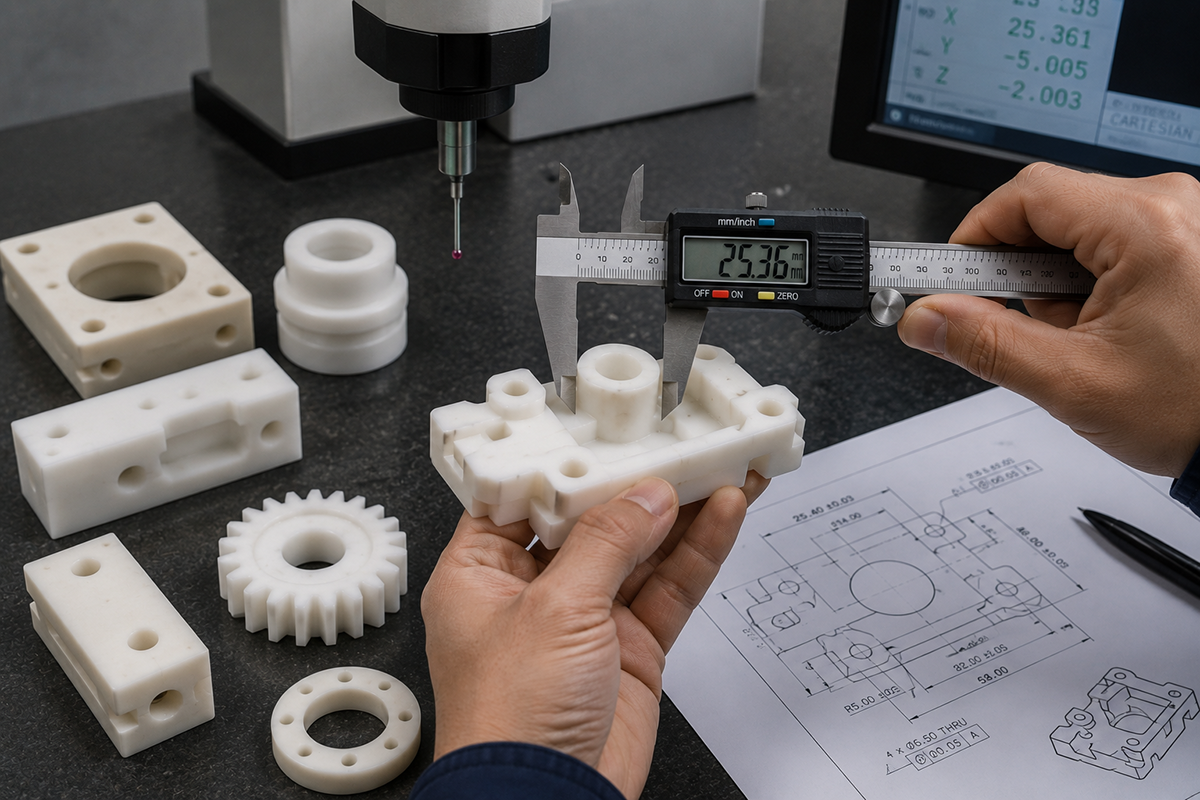
CNC machined plastic parts are used in many industrial and product-development applications. They are common in automation systems, robotics, electronics, fixtures, medical and laboratory equipment, packaging machinery, test devices, and custom mechanical assemblies.
Typical applications include wear pads, guides, rollers, bushings, spacers, insulators, covers, housings, blocks, plates, prototype parts, custom fixtures, soft jaws, and machine guards. Plastic parts are often selected when the design needs low friction, lower weight, electrical insulation, corrosion resistance, noise reduction, or non-metallic contact surfaces.
In automation and robotics, machined plastic components may reduce weight, protect metal parts from wear, or provide low-friction movement. In electronics, plastic parts may provide insulation, spacing, mounting support, or lightweight housing features. In chemical or laboratory applications, plastics such as PTFE or PEEK may be selected for chemical resistance or high-performance requirements.
The application should guide the material choice. A wear guide may need UHMW-PE or nylon. A precision bushing may work well in POM. A high-temperature chemical fixture may need PEEK. A clear cover may need acrylic or polycarbonate. Choosing the material based on the actual function is more reliable than selecting plastic only because it seems cheaper than metal.
Plastic vs Metal CNC Machining: When to Choose Plastic
Plastic should be chosen when the part benefits from low weight, insulation, low friction, chemical resistance, reduced noise, or non-metallic performance. Metal should be chosen when the part needs high strength, high stiffness, high temperature resistance, load-bearing capacity, or long-term structural durability.
Plastic is often better for sliding surfaces, electrical isolation, wear pads, lightweight covers, test fixtures, and components that should not scratch or damage mating metal parts. It can also reduce corrosion concerns in certain environments. For equipment where noise reduction or friction control matters, plastic may perform better than metal.
Metal remains better for structural brackets, shafts, high-load supports, heat-resistant parts, precision hard surfaces, and components exposed to high mechanical stress. If a part must carry heavy load or remain rigid under force, aluminum, stainless steel, steel, titanium, or brass may be more suitable. For early material selection, buyers can compare options through best materials for CNC machining.
A practical rule is to choose plastic when functional properties such as insulation, friction, weight, or chemical resistance matter more than structural strength. Choose metal when the part must carry load, resist heat, maintain high rigidity, or survive harsh mechanical conditions.
How to Reduce Cost and Improve Quality in Plastic Machining
Cost and quality are strongly influenced by design decisions. Buyers can reduce unnecessary cost by selecting the right plastic material, avoiding overly thin walls, using practical tolerances, simplifying deep pockets, and defining only the truly critical surfaces.
Material selection should match the application. PEEK is valuable when high performance is required, but it is unnecessary for many standard fixtures or covers. POM or ABS may be more practical when the part does not need extreme temperature or chemical resistance. Nylon may work well for wear parts, but moisture exposure should be considered.
Design changes can also improve quality. Thicker walls, larger internal radii, wider features, and better tool access can make machining more stable. Avoiding unnecessary small holes, sharp inside corners, and deep narrow slots can reduce machining time and risk.
Buyers should also allow supplier DFM feedback when the design is still flexible. A supplier may recommend a different material, adjusted tolerance, larger radius, or easier setup strategy that reduces cost without changing the part’s function.
What Buyers Should Prepare Before Requesting a Plastic CNC Quote
A complete RFQ helps the supplier quote accurately and avoid assumptions. Buyers should provide CAD files, 2D drawings, material requirements, quantity, tolerance notes, finish expectations, application environment, and inspection needs.
The drawing should identify critical dimensions, hole sizes, thread details, flatness requirements, mating features, and surface finish notes. If the material is flexible, the buyer should mention that alternatives are acceptable. This allows the supplier to recommend a better option based on machinability, availability, cost, and performance.
Application details are especially important for plastic parts. Buyers should explain whether the part will face heat, chemicals, moisture, friction, impact, electrical requirements, or long-term load. This helps confirm whether POM, nylon, PTFE, PEEK, ABS, polycarbonate, UHMW-PE, or another material is appropriate.
If the project is still in development, buyers should state whether the part is for prototype testing, low-volume production, or a bridge before injection molding. This helps the supplier plan the most practical approach. For broader material review, how to choose CNC machining materials can help buyers compare plastics with metal options before finalizing a drawing.
Conclusion
Plastic CNC machining works when a project needs functional plastic parts without mold tooling, especially for prototypes, low-volume production, design validation, fixtures, wear components, insulators, covers, and custom engineering parts. It gives buyers flexibility to test real materials, adjust designs, and produce useful parts before committing to high-volume tooling.
The process is especially valuable when the part needs low weight, electrical insulation, low friction, chemical resistance, impact behavior, reduced noise, or non-metallic performance. Materials such as POM, Delrin, nylon, PTFE, PEEK, ABS, polycarbonate, UHMW-PE, and acrylic each serve different functions, so material selection should be based on the application rather than price alone.
Plastic machining also has limitations. Heat sensitivity, clamping pressure, moisture absorption, flexibility, and long-term load can affect precision and stability. Buyers should use practical tolerances, avoid unnecessary thin walls and deep features, define critical surfaces clearly, and provide complete RFQ information.
When used for the right application, plastic CNC machining can be an efficient way to produce accurate, functional, and application-specific parts. If your project requires custom plastic components, our team can review your drawings and help evaluate material choice, tolerance feasibility, surface finish, quantity, and cost before production.