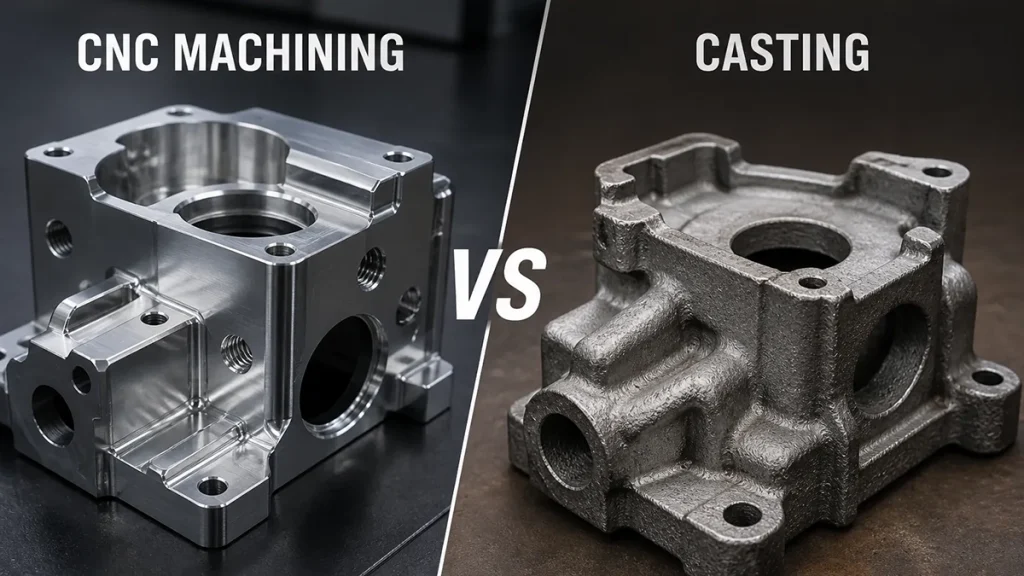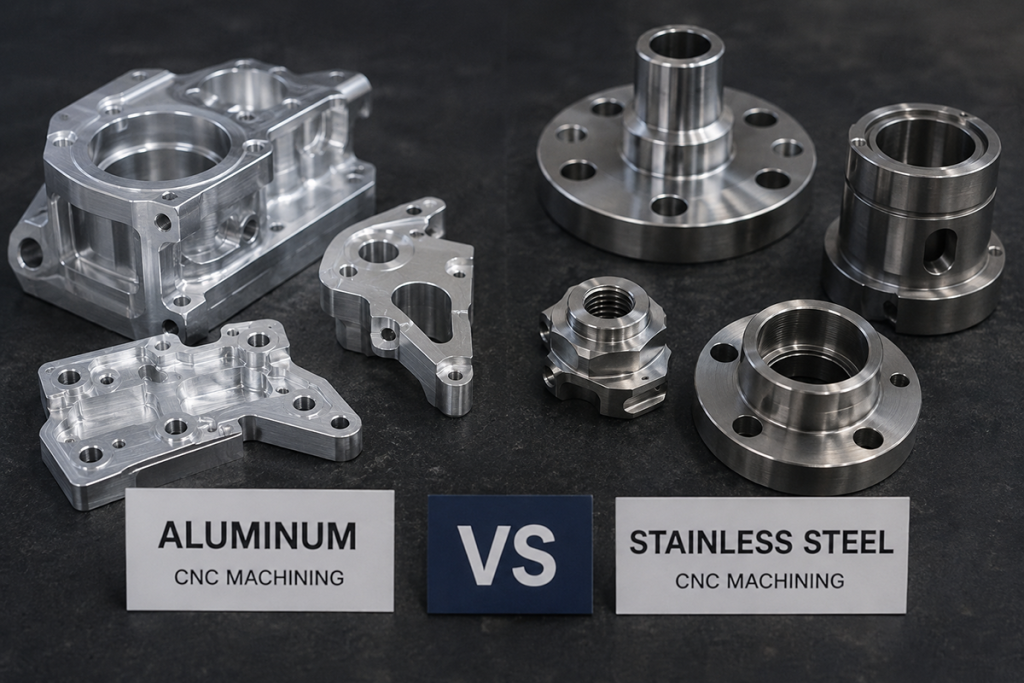
Introduction
How to choose CNC machining materials is one of the most important decisions engineers, product developers, and sourcing managers face before starting a custom machining project. The selected material affects not only the final part’s strength, weight, corrosion resistance, and appearance, but also machining cost, lead time, tolerance stability, surface finish, and long-term performance.
In many projects, material selection is discussed too late. A buyer may already have a CAD model and drawing, but the material is either unclear, over-specified, or chosen only because it was used in a previous design. This can lead to unnecessary machining cost, longer delivery time, or parts that do not perform well in the actual operating environment.
For example, aluminum may be ideal for a lightweight prototype or automotive bracket, while stainless steel may be better for a part exposed to moisture, chemicals, or heavy mechanical load. Brass may be suitable for precision fittings, copper may be selected for thermal or electrical performance, and engineering plastics may work well when weight, insulation, or low friction matters more than metal strength.
Choosing the right material is not about selecting the strongest or most expensive option. It is about matching the material to the part’s real function, operating environment, tolerance requirements, production quantity, and budget. A well-chosen material can reduce machining difficulty, improve part reliability, and make the entire manufacturing process more efficient.
This guide explains the key factors to consider when selecting materials for precision CNC machining services, including strength, weight, corrosion resistance, machinability, cost, surface finish, and application requirements. The goal is to help buyers make practical material decisions before sending a project for quotation.
Start with the Part’s Function
Before comparing specific metals or plastics, the first step in deciding how to choose CNC machining materials is to define what the part must actually do. Material selection should begin with function, not price or habit. A component used as a lightweight cover, a load-bearing bracket, a rotating shaft, or a corrosion-resistant fitting will each require a different material strategy.
Many sourcing mistakes happen because the material is selected too early without enough application context. For example, choosing stainless steel simply because it is “strong” may increase machining cost and part weight unnecessarily if aluminum would meet the actual load requirement. At the same time, choosing aluminum only to reduce cost may create performance issues if the part operates in a harsh, corrosive, or high-load environment.
Identify the Mechanical Requirement
The first question is whether the part is structural, functional, cosmetic, or protective. Structural and load-bearing parts require materials with suitable strength, rigidity, and fatigue resistance. Functional parts may need wear resistance, tight tolerance stability, or smooth sliding behavior. Protective covers and enclosures may prioritize weight, appearance, corrosion resistance, and ease of machining.
For example, an automotive mounting bracket may need good strength-to-weight performance, making aluminum 6061 or 7075 a practical option depending on load conditions. A heavy-duty industrial support block may require stainless steel or carbon steel because rigidity and long-term durability matter more than weight reduction. A precision bushing or fitting may use brass or bronze because of machinability and wear behavior.
Consider the Operating Environment
The environment where the part will be used strongly influences material choice. A component used indoors in a dry assembly line has very different requirements from a part exposed to moisture, chemicals, outdoor weather, cleaning fluids, or high temperatures.
Common environmental questions include:
- Will the part be exposed to moisture or outdoor conditions?
- Will it contact chemicals, oils, coolants, or cleaning agents?
- Does the part need corrosion resistance?
- Will the part experience heat, vibration, or repeated loading?
- Does the material need to be food-safe, medical-compatible, or electrically conductive?
For controlled indoor use, aluminum or engineering plastic may be sufficient. For outdoor, marine, or chemical exposure, stainless steel or a protected aluminum finish may be required. For electrical or thermal applications, copper or brass may be more appropriate.
Match Material to Assembly Requirements
Material selection also depends on how the part interacts with other components. If the part includes threads, press fits, bearing seats, sliding surfaces, or sealing areas, the material must support those functions reliably. Some materials machine easily but may not hold threads as strongly as required. Others offer strength but may increase tool wear and machining cost.
Buyers should also consider whether the part needs post-processing such as anodizing, passivation, plating, polishing, or heat treatment. These processes may improve performance, but they also affect cost, lead time, and sometimes final dimensions.
For custom CNC machining projects, the best material choice comes from understanding the part’s function first. Once the functional requirement is clear, material options can be compared based on machinability, cost, strength, corrosion resistance, and lead time. This approach helps avoid both under-specifying and over-specifying materials.
Compare Strength, Weight, and Material Performance
After defining the part’s function, the next step in how to choose CNC machining materials is to compare strength, weight, stiffness, and long-term performance. These properties determine whether the finished component can handle real operating conditions without bending, wearing, cracking, corroding, or failing prematurely. For engineers and sourcing managers, this comparison is more useful than simply asking which material is “best.” The best material is the one that matches the load, environment, and production goal of the specific part.
Strength and Load Requirements
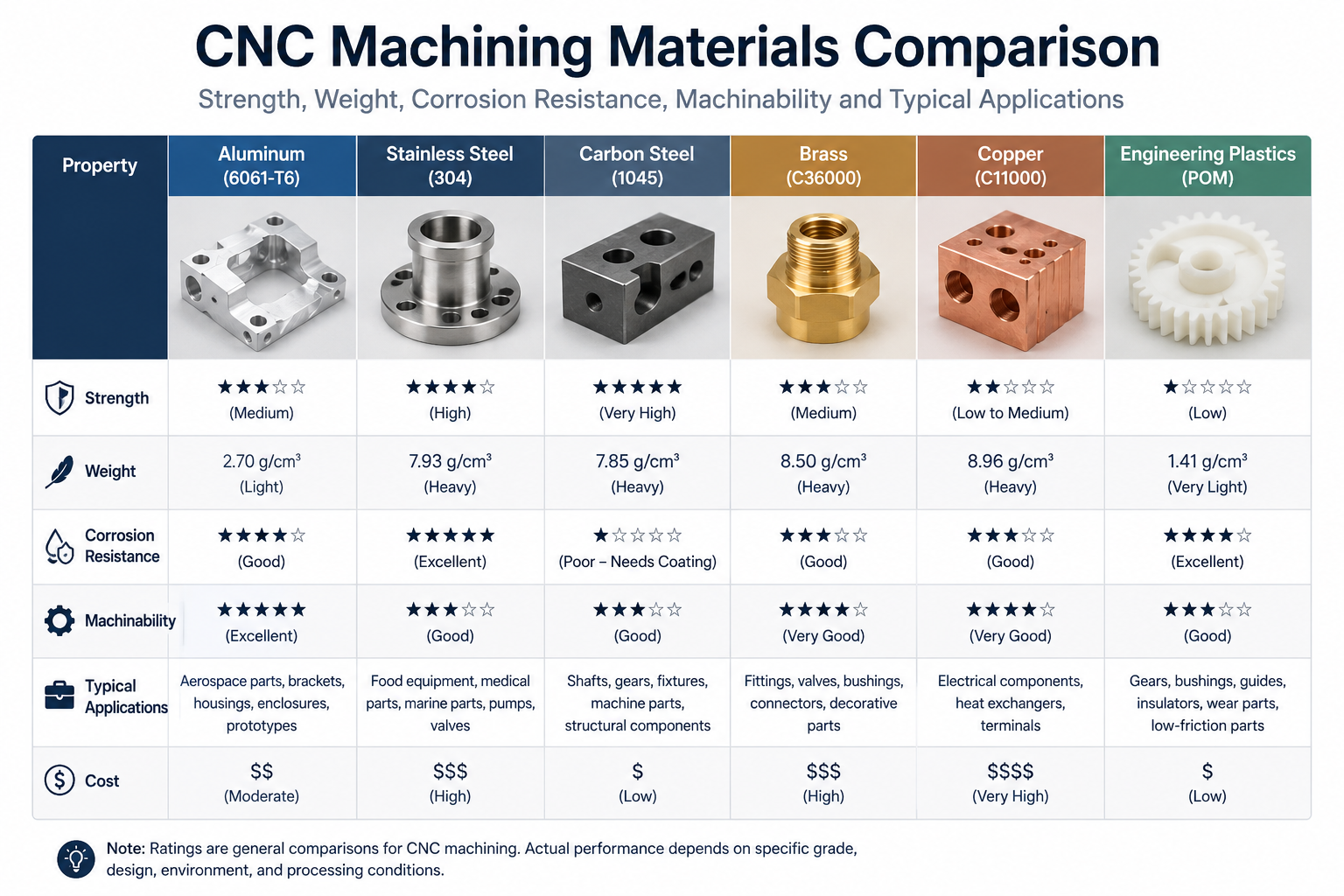
Strength matters when a part carries load, supports another component, resists impact, or operates under repeated mechanical stress. Stainless steel, carbon steel, alloy steel, and titanium generally provide higher strength than common aluminum grades, but they also come with higher machining difficulty, greater weight, and increased production cost.
Aluminum alloys such as 6061 and 7075 are popular because they offer a good balance of strength, weight, machinability, and cost. 6061 aluminum is widely used for brackets, housings, plates, and general industrial components. 7075 aluminum provides higher strength and is often selected for more demanding lightweight structures, but it can be more expensive and may not be necessary for every application.
Stainless steel is often selected when the part must provide strength and corrosion resistance at the same time. This makes it suitable for industrial equipment, outdoor systems, food-related machinery, marine environments, and components exposed to cleaning fluids or moisture. However, stainless steel is heavier and slower to machine than aluminum, which affects both cost and lead time.
Weight and Motion Performance
Weight becomes important when the part is used in moving systems, portable equipment, automotive assemblies, robotics, or aerospace-related applications. A lighter part can reduce load on motors, improve energy efficiency, and make assembly easier. In these cases, aluminum is often preferred because it is significantly lighter than steel and stainless steel while still offering useful mechanical performance.
For example, a robotic arm bracket made from aluminum may reduce system weight and improve movement response. A stainless steel version may be stronger, but the additional weight could increase motor load and reduce efficiency. This is why material selection should always consider how the part interacts with the full system, not only how strong the material is by itself.
Stiffness, Stability, and Fatigue
Some projects require stiffness more than basic strength. A material may be strong enough not to break, but still flex too much under load. This can be a problem for fixtures, machine bases, alignment plates, and precision supports. Steel and stainless steel generally provide higher stiffness than aluminum, making them better for heavy-duty applications where dimensional stability under load is important.
Fatigue performance also matters for parts exposed to repeated stress cycles. Components used in machinery, vibration environments, or transportation systems should be evaluated for long-term durability. In these cases, material grade, part geometry, surface finish, and stress concentration points all affect performance.
Practical Material Performance Guidance
A useful way to approach material performance is to ask what failure mode matters most. If the main concern is weight, aluminum may be the best starting point. If corrosion and strength are both critical, stainless steel may be more suitable. If electrical conductivity matters, copper or brass may be better. If low friction or insulation is required, engineering plastics may be appropriate.
- Choose aluminum for lightweight structures, prototypes, brackets, housings, and fast machining.
- Choose stainless steel for corrosion resistance, strength, durability, and harsh environments.
- Choose carbon or alloy steel for high-load mechanical parts where corrosion resistance is less important or can be managed with coating.
- Choose brass or copper for electrical, thermal, or precision fitting applications.
- Choose engineering plastics for lightweight, low-friction, insulating, or non-metallic components.
For buyers reviewing CNC machining materials, the safest approach is to compare performance requirements before choosing the material. A practical material decision can reduce machining difficulty, control cost, and ensure the finished part performs reliably in its real application.
Evaluate Machinability and Production Efficiency
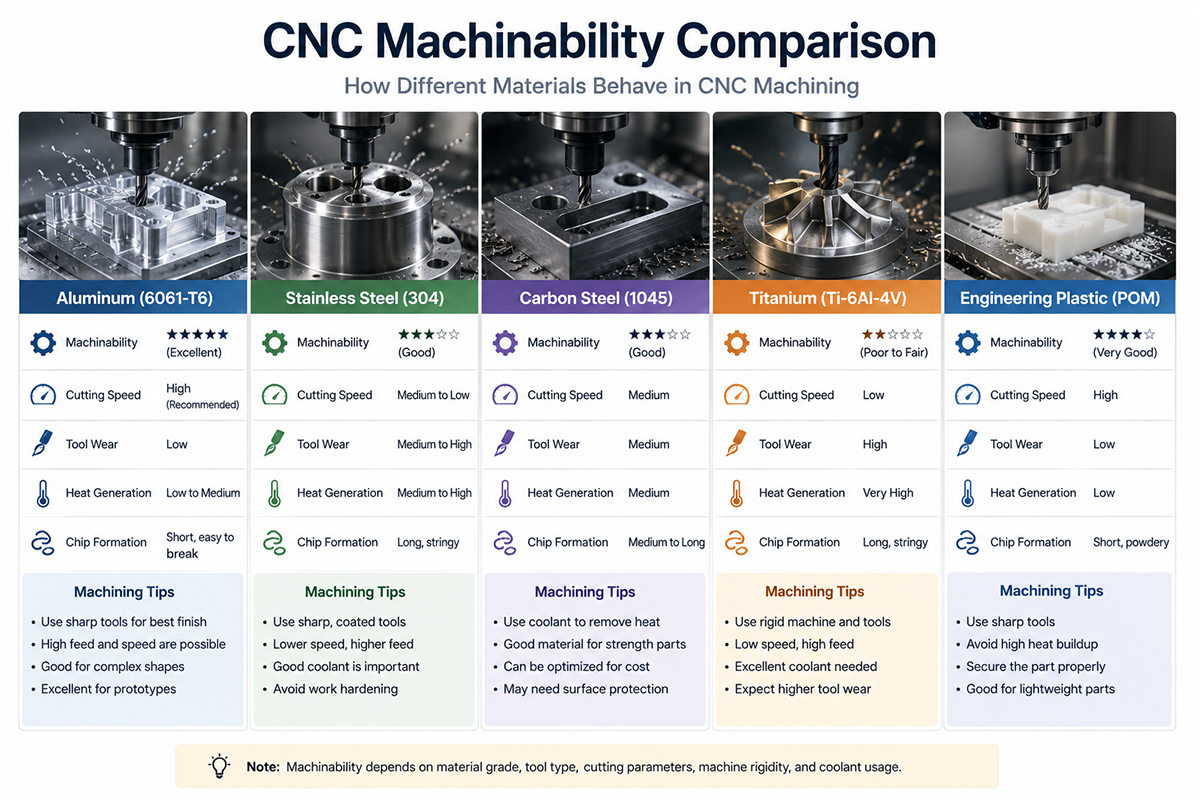
Another important part of how to choose CNC machining materials is understanding machinability. Even if two materials can both meet the functional requirements of a part, they may behave very differently during machining. Machinability affects cutting speed, tool wear, heat generation, surface finish, tolerance stability, and final cost. For sourcing managers, this means material choice directly influences both pricing and lead time.
A material with good machinability can usually be cut faster, with less tool wear and more stable surface quality. A material that is difficult to machine may require slower feeds, stronger tooling, more coolant control, and additional inspection. This does not mean difficult materials should be avoided, but they should be selected only when their performance benefits justify the added production cost.
Why Aluminum Is Often More Cost-Efficient
Aluminum is one of the most efficient materials for CNC machining. Common grades such as 6061 machine quickly, produce manageable chips, and allow high cutting speeds. This makes aluminum especially useful for prototypes, brackets, housings, plates, and lightweight industrial components.
Because aluminum is easier to cut than stainless steel or titanium, it often supports shorter cycle times and lower tooling cost. For projects where weight reduction, fast turnaround, and reasonable strength are priorities, aluminum can provide an excellent balance between performance and manufacturing efficiency.
However, aluminum is not automatically suitable for every project. If the part needs high wear resistance, stronger thread durability, or long-term performance in harsh chemical environments, another material may be required.
Why Stainless Steel Costs More to Machine
Stainless steel is widely used in CNC machining because it provides strength, durability, and corrosion resistance. However, it is more difficult to machine than aluminum. Stainless steel generates more cutting resistance and heat, which increases tool wear and slows production speed. Some stainless grades can also work-harden if cutting conditions are not controlled properly.
This means stainless steel parts may require:
- Slower machining speeds
- More rigid setups
- Higher-quality cutting tools
- Careful coolant management
- Additional finishing or inspection steps
For buyers, the higher cost of stainless steel machining is usually justified when the part must resist corrosion, moisture, chemicals, or high mechanical stress. If these requirements are not present, aluminum or another material may provide a more cost-effective solution.
Other Materials and Machining Behavior
Brass and some copper alloys generally machine well and are often used for fittings, electrical components, and precision parts. Copper provides excellent electrical and thermal conductivity, but it can be more challenging to machine cleanly depending on the grade. Titanium offers excellent strength-to-weight performance, but it is expensive to machine because it retains heat and accelerates tool wear.
Engineering plastics also vary widely. Materials such as POM, nylon, PTFE, and ABS can be useful for lightweight, low-friction, or insulating components, but they require careful control to avoid deformation, poor chip control, or dimensional instability.
Machinability Should Match Project Priorities
Machinability should not be considered separately from performance. A material that is easy to machine but unsuitable for the operating environment may fail in use. A material that performs well but is unnecessarily difficult to machine may increase cost without adding real value.
A practical material decision should balance:
- Required mechanical strength
- Machining speed and tool wear
- Surface finish expectations
- Tolerance stability
- Material availability
- Total production cost
For custom CNC machining projects, discussing machinability early can prevent unnecessary cost increases. If the required performance can be achieved with a more machinable material, the project may benefit from shorter lead time, lower cost, and more predictable production results.
Consider Corrosion Resistance and Operating Environment
When deciding how to choose CNC machining materials, corrosion resistance should be evaluated together with the part’s operating environment. A material that performs well in a clean indoor assembly may not be suitable for outdoor use, marine exposure, chemical contact, high humidity, or repeated cleaning. If environmental conditions are ignored, the finished part may corrode, discolor, lose strength, or require replacement earlier than expected.
Corrosion resistance is especially important for industrial equipment, automotive components, food-processing machinery, medical devices, outdoor hardware, and fluid-handling systems. In these applications, the material must not only meet dimensional requirements after CNC machining, but also remain stable during long-term use.
When Aluminum Is Suitable
Aluminum naturally forms a thin oxide layer that provides basic corrosion resistance in many environments. This makes it useful for lightweight housings, brackets, covers, machine parts, robotic components, and automotive prototypes. Aluminum is also widely selected when the project needs a balance of low weight, good machinability, and reasonable environmental performance.
However, aluminum may need additional surface treatment when exposed to moisture, salt, chemicals, or abrasion. Common treatments include anodizing, powder coating, and chemical conversion coating. These finishes can improve corrosion resistance, appearance, and wear protection, but they also affect cost, lead time, and sometimes dimensional tolerance.
When Stainless Steel Is Better
Stainless steel is often the preferred material when corrosion resistance is a primary requirement. Grades such as 304 and 316 stainless steel are commonly used in environments where moisture, cleaning agents, outdoor exposure, or chemical contact are expected. Compared with aluminum, stainless steel generally provides better long-term resistance in harsh conditions.
Typical applications include:
- Food-processing equipment
- Marine and outdoor components
- Chemical handling parts
- Medical and laboratory fixtures
- Industrial machinery exposed to moisture or cleaning fluids
Stainless steel is heavier and more expensive to machine than aluminum, but those costs may be justified if the part must maintain durability in a corrosive environment. For parts where failure, rust, or contamination would create serious problems, stainless steel is usually the safer material choice.
Other Material Options for Special Environments
Some projects require more specialized material choices. Brass may be suitable for fittings, valves, and components where corrosion resistance and machinability are both important. Copper may be selected for thermal or electrical conductivity, although it may require careful machining control. Engineering plastics can also be useful in environments where low friction, insulation, chemical resistance, or reduced weight are required.
For higher-performance applications, titanium may be considered when strength, corrosion resistance, and low weight must be combined. However, titanium is significantly more expensive to machine, so it is usually reserved for demanding aerospace, medical, or advanced industrial applications.
Do Not Over-Specify Corrosion Resistance
A common sourcing mistake is choosing a high-cost corrosion-resistant material when the operating environment does not require it. For example, using 316 stainless steel for a dry indoor bracket may increase cost unnecessarily if aluminum or 304 stainless steel would perform well. On the other hand, using untreated aluminum in a saltwater or chemical environment may reduce service life and increase replacement cost.
The best material choice should be based on real exposure conditions. Before selecting a material, buyers should confirm whether the part will face moisture, salt, cleaning fluids, oils, chemicals, temperature variation, or outdoor weather. If the environment is unclear, sharing application details with the supplier can help avoid both under-specifying and over-specifying the material.
For CNC machined parts, corrosion resistance is not only a material question. It may also involve surface treatment, coating thickness, finish requirements, and inspection after processing. Evaluating these factors early helps ensure the final part performs reliably without creating unnecessary machining or finishing costs.
Balance Cost, Availability, and Lead Time
Cost is one of the most practical considerations when deciding how to choose CNC machining materials, but it should never be judged by raw material price alone. The final cost of a CNC machined part depends on material price, machinability, tool wear, cycle time, setup difficulty, surface treatment, inspection requirements, and material availability. A material that looks cheaper at first may become more expensive if it is difficult to machine or requires additional finishing.
For engineers and sourcing managers, the goal is to choose a material that meets the part’s real performance requirements without adding unnecessary manufacturing cost. This means comparing not only what the material costs to buy, but how it behaves throughout the machining process.
Raw Material Cost vs Total Machining Cost
Raw material cost is only one part of the quotation. Aluminum is often cost-efficient because common grades such as 6061 are widely available and easy to machine. Stainless steel usually costs more to process because it requires slower cutting speeds, stronger tools, and more careful heat control. Titanium, copper, and certain specialty alloys may increase cost further due to material price, machining difficulty, or limited availability.
For example, a stainless steel part may be more expensive than an aluminum part even if both are similar in size. The difference may come from longer machine time, increased tool wear, more coolant control, and additional inspection. In contrast, aluminum can often reduce both material handling time and machining cycle time, making it a strong choice when the application does not require stainless steel’s corrosion resistance or strength.
Material Availability Affects Lead Time
Availability is another major factor. Common materials are usually easier to source, which helps keep projects moving quickly. If a project uses standard sizes of 6061 aluminum, 7075 aluminum, 304 stainless steel, or 316 stainless steel, the supplier may be able to begin production faster. Uncommon alloys, special thicknesses, certified materials, or imported stock can extend lead time before machining even begins.
This is especially important for prototype and small-batch projects. If the timeline is tight, choosing a readily available material may be more practical than waiting for a specialty alloy that offers only minor performance improvements.
Surface Treatment and Secondary Costs
Some materials also require additional finishing to meet the application’s needs. Aluminum may require anodizing or coating for corrosion resistance and appearance. Stainless steel may require passivation or polishing. Carbon steel may need plating, coating, or black oxide treatment to prevent rust. Engineering plastics may require special handling to maintain dimensional stability.
These finishing steps can improve performance, but they also add cost and lead time. Buyers should confirm whether the finish is truly necessary for function or whether it is mainly cosmetic. In some cases, changing the base material may reduce the need for additional surface treatment.
How to Control Material-Related Cost
Buyers can often reduce CNC machining cost by making practical material decisions early. Useful steps include:
- Choose common material grades when performance allows
- Avoid specialty alloys unless the application requires them
- Confirm whether material certification is necessary
- Use aluminum when lightweight performance and fast machining are priorities
- Use stainless steel only when corrosion resistance or strength justifies the cost
- Clarify surface treatment requirements before requesting a quote
- Ask for alternative material suggestions if the original material is flexible
For buyers preparing an RFQ, it is helpful to state whether the material is fixed or open to supplier recommendation. If the application requirements are clear, an experienced machining supplier can often suggest a more cost-effective material that still meets functional needs.
Choosing the right material is not simply about lowering the price. It is about avoiding unnecessary cost while protecting part performance, delivery schedule, and long-term reliability.
Think About Surface Finish and Post-Processing
Surface finish and post-processing are important parts of how to choose CNC machining materials because different materials respond very differently after machining. A material may be suitable from a strength or cost perspective, but if it cannot achieve the required surface appearance, coating performance, corrosion resistance, or functional finish, it may not be the best choice for the project.
In CNC machining, surface finish is not only cosmetic. It can affect sealing, sliding contact, friction, coating adhesion, corrosion protection, cleanliness, and assembly quality. This is why material selection should be considered together with the final finish requirement before the part is quoted or manufactured.
Aluminum Surface Finish Options
Aluminum is one of the most flexible materials for surface finishing. It machines cleanly, produces good surface quality, and supports common finishing processes such as anodizing, bead blasting, powder coating, and chemical conversion coating. This makes aluminum a strong option for visible housings, brackets, panels, enclosures, and lightweight structural components.
Anodizing is especially common for aluminum CNC machined parts because it improves corrosion resistance while giving the part a cleaner and more consistent appearance. Clear, black, and colored anodized finishes are often used for industrial equipment, electronics housings, robotics components, and automotive prototypes.
However, anodizing can slightly affect dimensions, especially on tight-tolerance surfaces. If a part includes precision holes, bearing fits, threaded areas, or sealing faces, the finish thickness should be considered during design and manufacturing planning.
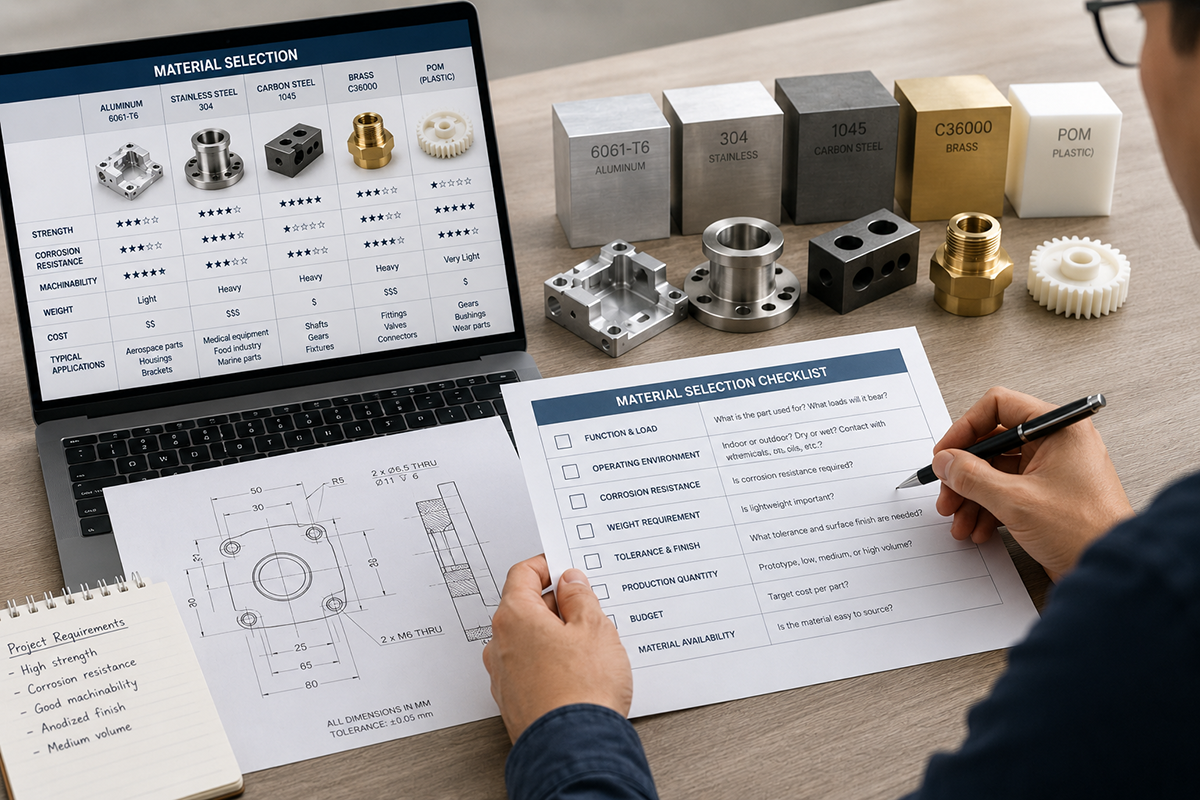
Stainless Steel Surface Finish Options
Stainless steel is often selected when corrosion resistance and durability are priorities. It can be machined to a clean finish and may be further processed through passivation, polishing, brushing, or bead blasting depending on the application.
Passivation is commonly used to improve corrosion resistance by removing surface contamination and enhancing the protective oxide layer. Polishing may be required for food-processing, medical, laboratory, or visible industrial components where cleanliness and appearance matter.
Compared with aluminum, stainless steel finishing can require more labor and time, especially when a polished or highly uniform surface is required. Buyers should confirm whether the finish is functional, cosmetic, or both.
Carbon Steel, Brass, Copper, and Plastics
Carbon steel can provide good strength at a reasonable material cost, but it usually requires protective finishing if corrosion resistance is needed. Common options include black oxide, plating, powder coating, or painting. Without protection, carbon steel may rust in humid or outdoor environments.
Brass and copper can machine well and offer attractive natural appearances, but they may oxidize or discolor over time depending on the environment. These materials are often selected for electrical, thermal, or fitting applications rather than cosmetic performance alone.
Engineering plastics may not require coating, but they can be sensitive to heat, clamping pressure, and surface scratches during machining. Their surface finish depends strongly on material type, tool sharpness, and cutting conditions.
Match Finish Requirements to the Application
Before choosing a material, buyers should define whether the surface finish is needed for function, protection, appearance, or all three. This helps avoid unnecessary finishing cost and prevents selecting a material that requires excessive post-processing.
- For corrosion protection: Consider anodized aluminum, stainless steel, coated steel, or suitable plastics.
- For visible appearance: Aluminum with anodizing or stainless steel with brushing/polishing may be suitable.
- For sealing or sliding contact: Focus on machined surface roughness and tolerance control.
- For electrical or thermal performance: Copper or brass may be more appropriate.
For CNC machined parts, the best finish strategy is decided before production begins. Clear finish requirements allow the supplier to select the right machining approach, account for coating thickness, protect critical surfaces, and avoid delays caused by unclear appearance expectations.
Common CNC Machining Materials and When to Use Them
After reviewing function, strength, machinability, corrosion resistance, cost, and finishing requirements, the next step in how to choose CNC machining materials is to understand where common materials fit in real projects. Each material has a practical use range. The goal is not to memorize every alloy specification, but to recognize which material family is most appropriate for a given part type, operating environment, and production requirement.
Aluminum: Best for Lightweight and Cost-Efficient Machining
Aluminum is one of the most widely used CNC machining materials because it offers a strong balance of lightweight performance, machinability, cost efficiency, and surface finish options. Common grades such as 6061 are suitable for brackets, housings, plates, covers, fixtures, and prototype parts. Aluminum 7075 is stronger and often used when higher mechanical performance is required, although it usually costs more than 6061.
Aluminum is a strong choice when the project requires:
- Lightweight structural parts
- Fast prototype machining
- Good surface finish
- Lower machining cost
- Anodized appearance or corrosion protection
It may not be the best choice for very high-load, high-wear, or harsh chemical environments unless the correct alloy and surface treatment are selected.
Stainless Steel: Best for Strength and Corrosion Resistance
Stainless steel is often selected when durability and corrosion resistance are more important than machining speed. Grades such as 304 and 316 are common in industrial equipment, food-processing machinery, outdoor components, medical fixtures, and parts exposed to moisture or cleaning agents.
Stainless steel is suitable when the part requires:
- Corrosion resistance
- Higher strength than aluminum
- Long-term durability
- Resistance to moisture or cleaning fluids
- Stable performance in demanding environments
The trade-off is higher machining cost. Stainless steel is heavier, harder to cut, and typically requires slower machining speeds than aluminum.
Carbon Steel and Alloy Steel: Best for Heavy-Duty Mechanical Parts
Carbon steel and alloy steel are commonly used for mechanical parts that require strength, rigidity, and wear resistance. These materials are often found in shafts, supports, fixtures, machine components, and industrial tooling. They can be cost-effective for heavy-duty parts, but corrosion protection may be needed depending on the environment.
These materials are useful when the project prioritizes:
- High strength
- Rigidity under load
- Wear resistance
- Mechanical durability
- Industrial equipment performance
If corrosion is a concern, coatings, plating, black oxide, or painting may be required.
Brass and Copper: Best for Conductivity and Precision Fittings
Brass is known for good machinability and is often used for fittings, bushings, valves, connectors, and precision components. Copper is selected when electrical or thermal conductivity is the main requirement. These materials are valuable in electrical systems, heat transfer applications, fluid control components, and specialized industrial parts.
Brass and copper may be suitable when the part requires:
- Electrical conductivity
- Thermal conductivity
- Good machinability
- Precision fitting performance
- Corrosion resistance in certain environments
Material cost can be higher than aluminum or common steels, so they should be selected based on functional need rather than appearance alone.
Engineering Plastics: Best for Lightweight, Insulation, and Low Friction
Engineering plastics such as POM, nylon, PTFE, ABS, and polycarbonate are useful when metal is not required. They may be selected for lightweight components, insulating parts, wear pads, bushings, guides, covers, and low-friction applications.
Plastics can be useful when the project requires:
- Low weight
- Electrical insulation
- Low friction
- Chemical resistance
- Reduced noise or vibration
However, plastics may be less dimensionally stable than metals under heat, load, or moisture. Material behavior should be reviewed carefully before selecting plastics for precision or high-load applications.
For buyers comparing material options, the most practical approach is to start with the application requirement, then narrow the choice based on machinability, cost, lead time, and finishing needs. This avoids over-specifying expensive materials while still ensuring the final part performs reliably.
How to Prepare a Material Decision Before Requesting a Quote
Once the possible material options are clear, the final step in how to choose CNC machining materials is preparing the information needed for an accurate quotation. A supplier can provide better material guidance when the project includes more than just a CAD model. For CNC machining, material selection is closely connected to geometry, tolerance, finishing, production quantity, and real operating conditions. If these details are unclear, the supplier may quote conservatively or select a material that is technically safe but not cost-efficient.
Provide Application Context
One of the most helpful details buyers can provide is how the part will be used. A drawing may show dimensions, holes, and surface features, but it does not always explain the working environment. For example, a simple mounting bracket may be used indoors on a light-duty assembly, or it may be exposed to vibration, outdoor moisture, and repeated mechanical load. These two cases may require different material choices.
Useful application details include:
- Whether the part is load-bearing or non-structural
- Whether it will be used indoors, outdoors, or in a wet environment
- Whether it will contact chemicals, oils, coolant, or cleaning fluids
- Whether weight reduction is important
- Whether corrosion resistance is required
- Whether the part is a prototype, test sample, or production component
This context helps the supplier avoid unnecessary material assumptions and recommend a practical option based on real use conditions.
Clarify Whether the Material Is Fixed or Flexible
Some projects require a specific material grade because of engineering standards, customer requirements, or previous validation. In these cases, the RFQ should state the exact grade clearly, such as 6061-T6 aluminum, 7075 aluminum, 304 stainless steel, or 316 stainless steel.
Other projects may have more flexibility. If the part only needs to meet general strength, weight, or corrosion requirements, buyers can allow the supplier to suggest alternatives. This can be useful when the original material is expensive, difficult to source, or harder to machine than necessary.
A simple note such as “material alternatives acceptable if performance is maintained” can help open the door to better cost and lead time options.
Connect Material Choice with Tolerance and Finish
Material selection should also be reviewed together with tolerance and surface finish. Some materials are easier to hold to tight tolerances. Some respond better to anodizing, polishing, passivation, coating, or plating. If a part requires both precision and a surface treatment, the supplier needs to consider how the finish may affect dimensions.
For example, an aluminum part with anodizing may need coating thickness considered on tight-fit features. A stainless steel part requiring polishing may need additional finishing allowance. A plastic part may need tolerance review because thermal expansion and material flexibility can affect dimensional stability.
Request Multiple Options When Appropriate
For cost-sensitive projects, it can be useful to ask for quotation options based on different materials. For example, a buyer may request pricing for both aluminum 6061 and stainless steel 304 if both are technically possible. This allows comparison of cost, lead time, weight, corrosion resistance, and machining difficulty before final selection.
However, material options should be realistic. Comparing materials that cannot meet the part’s function may waste time. The best comparison is between materials that are all technically suitable but differ in cost, lead time, or performance margin.
For custom projects, providing clear RFQ information helps the supplier quote more accurately and recommend materials that match both performance and budget. A good material decision reduces production risk, improves machinability, and supports a smoother path from prototype to final part.
Conclusion
How to choose CNC machining materials is not a question of selecting the strongest, cheapest, or most familiar material. The right choice depends on how the part will function, where it will be used, what mechanical loads it must handle, how precise it needs to be, and how efficiently it can be machined. A good material decision supports both product performance and manufacturing efficiency.
For lightweight prototypes, brackets, housings, and fast-turnaround projects, aluminum is often a practical starting point because it offers strong machinability, lower weight, and good cost control. For parts exposed to moisture, chemicals, outdoor conditions, or higher mechanical stress, stainless steel may provide better long-term reliability despite higher machining cost. Carbon steel and alloy steel are useful for heavy-duty mechanical parts, while brass, copper, and engineering plastics serve more specialized needs such as conductivity, fittings, insulation, or low-friction performance.
The most important principle is to match the material to the real application. Over-specifying a material can increase cost, lead time, and machining difficulty without improving the final part. Under-specifying a material can lead to corrosion, deformation, wear, assembly problems, or early failure. Both mistakes can be avoided by reviewing function, environment, tolerance, finish, quantity, and budget before production begins.
For engineers and sourcing managers, material selection should also be discussed before requesting a quote. A complete RFQ with CAD files, drawings, material requirements, finish expectations, and application context helps the supplier evaluate whether the selected material is practical or whether an alternative may reduce cost while maintaining performance.
If your project requires custom machined parts and you are unsure which material is most suitable, our team can review your design and provide practical guidance based on machinability, tolerance requirements, surface finish, production quantity, and real operating conditions. A clear material decision at the beginning of the project can reduce unnecessary cost and support more reliable CNC machining results.