Introduction
CNC parts for robotics are used when robot systems require accurate dimensions, stable assembly, lightweight structures, and repeatable motion performance. In robotics, a part is not only judged by whether it matches a drawing. It must support controlled movement, proper alignment, reliable fastening, low vibration, and consistent performance across repeated cycles.
For buyers in North America, Europe, and other overseas markets sourcing custom robotics components, precision and repeatability are critical. A small dimensional error in a mounting hole, bearing seat, gripper jaw, sensor bracket, or end-effector plate can affect motion accuracy, gripping performance, calibration, or long-term reliability. This is especially important for robot arms, automation systems, machine vision equipment, end-of-arm tooling, and custom industrial robots.
CNC machining is widely used for robotics projects because it can produce functional parts from aluminum, stainless steel, engineering plastics, brass, titanium, and other materials without requiring molds or dedicated tooling. This makes it suitable for prototypes, low-volume production, design validation, custom automation equipment, and replacement components.
Robotics applications often require a balance between strength, weight, stiffness, and manufacturability. Aluminum may be selected for lightweight robot brackets and arm components. Engineering plastics may be used for low-friction pads, guides, insulators, or gripper contact surfaces. Stainless steel may be used when strength or wear resistance is more important. The best material depends on load, motion, environment, surface finish, and assembly requirements.
Why Precision Matters in Robotics CNC Parts
Precision matters in robotics because robotic movement depends on controlled alignment between multiple components. A robot arm, gripper, sensor mount, or end-effector plate may include several holes, slots, bearing seats, dowel pin locations, and mating faces. If those features are not positioned correctly, the system may still assemble, but movement accuracy can suffer.
In a robot assembly, small dimensional errors can accumulate. A slightly misaligned bracket may change the position of a sensor. A bearing seat that is not concentric may create vibration. A mounting plate that is not flat may shift the position of an end effector. These problems are often difficult to correct after assembly because they affect calibration, repeat motion, and long-term wear.
Precision is also important because robotics parts often interact with motors, bearings, rails, sensors, cameras, pneumatic components, and control systems. Mechanical accuracy supports electrical and software accuracy. Even advanced control systems cannot fully compensate for poor mechanical alignment or unstable assembly fit.
For this reason, robotics CNC machining should focus on the features that affect motion and assembly. Critical dimensions may include hole position, bearing fits, flatness, parallelism, perpendicularity, thread quality, and surface finish on contact areas. Non-critical outside profiles may not need the same tolerance level, but functional interfaces should be clearly defined on the drawing.
What Repeatability Means for CNC Machined Robot Components
Repeatability means more than producing one accurate part. For CNC machined robot parts, repeatability means that multiple parts can be produced with consistent dimensions, finish, and assembly behavior from one batch to the next. This is especially important when a robotics project moves from prototype testing to low-volume production or repeated equipment builds.
In robotics projects, accuracy and repeatability are related but not identical. Accuracy describes how close a component or motion result is to the intended target, while repeatability describes how consistently the same result can be achieved over repeated cycles. When defining inspection and motion-related requirements, buyers can use this accuracy and precision overview as a general reference.
A gripper jaw may need to apply the same contact position across several units. A sensor bracket may need to hold the same angle and distance for calibration. A robot arm adapter plate may need to match the same bolt pattern and mounting face every time. If each part varies too much, assembly becomes slower, calibration becomes less predictable, and field replacement becomes more difficult.
Repeatability also supports maintenance. Robotic systems often require replacement gripper pads, brackets, fixtures, spacers, or adapter plates. If replacement parts are not consistent with the original design, the robot may need adjustment or recalibration. For production environments, this can increase downtime and reduce equipment reliability.
To improve repeatability, drawings should identify critical features, suppliers should control tooling and inspection, and batch production should use stable workholding and process planning. First article inspection, thread gauges, pin gauges, CMM checks, and surface finish verification may be useful when the part affects alignment or motion performance.
Common CNC Parts Used in Robotics
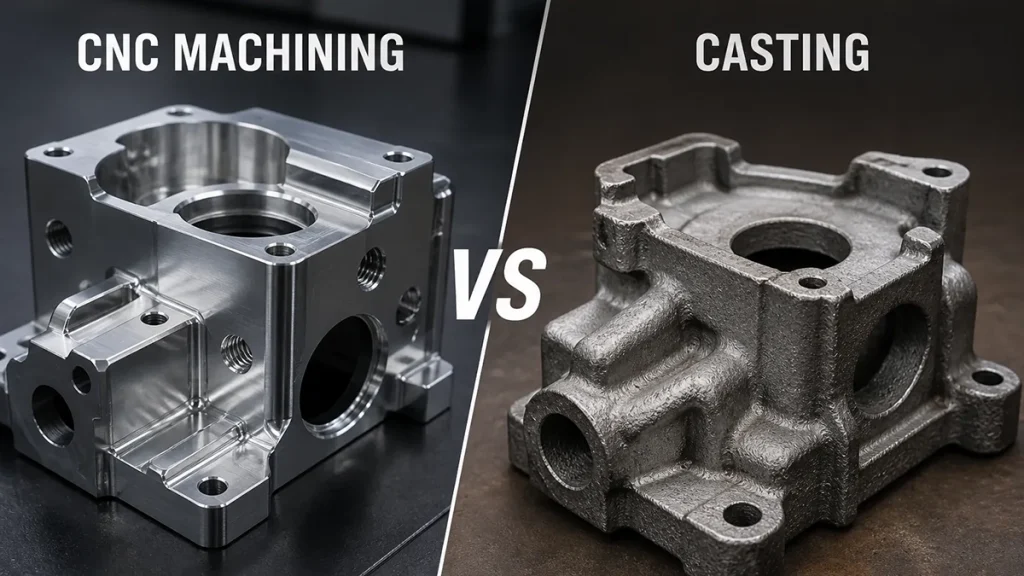
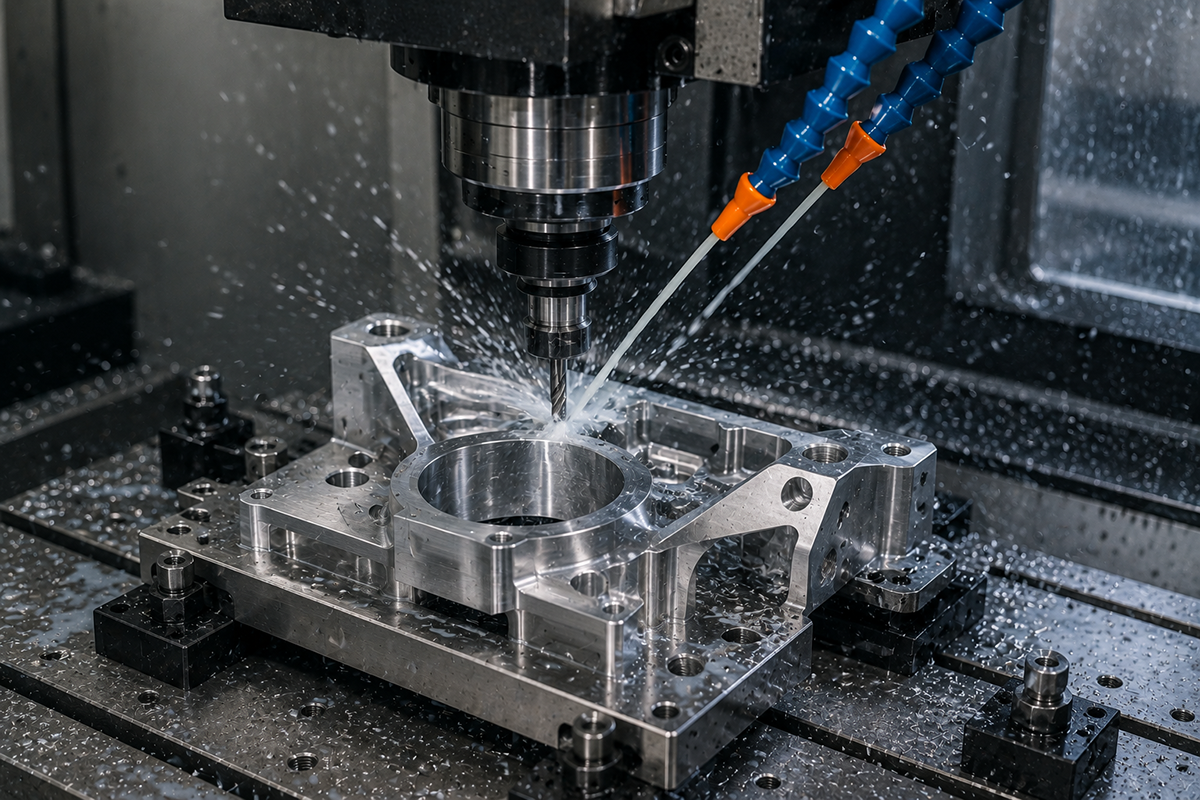
CNC machining is used for many robotics components because it supports complex shapes, accurate holes, material flexibility, and fast design changes. Robotics projects often include custom assemblies that are not available as standard catalog parts. CNC machining allows engineers to create these components without investing in dedicated tooling during early development.
Common CNC machined robot parts include robot arm brackets, end-effector plates, gripper jaws, sensor mounts, motor mounts, gearbox housings, adapter plates, bearing blocks, linear guide components, spacer blocks, fixture plates, and lightweight structural members. These parts often connect motors, sensors, actuators, rails, pneumatic cylinders, cameras, and tooling.
End-effector and gripper components are especially common. A custom gripper jaw may need specific contact geometry, soft insert mounting, lightweight structure, or replaceable wear surfaces. CNC machining allows these features to be tested and modified quickly before the final design is frozen.
Robot arm and automation brackets also benefit from CNC machining because they often require accurate hole patterns, strong mounting faces, and lightweight geometry. In many cases, the part must be rigid enough to resist vibration but light enough to reduce load on motors and actuators.
For custom robotics parts, experienced custom CNC machining services can help review whether the part geometry, material, tolerance, and surface finish are practical before production begins.
Key Precision Requirements for Robotics Components
Robotics components often have several critical precision requirements. The most important features are usually not the visible outside shape, but the interfaces that control assembly, alignment, and motion. Buyers should mark these features clearly so the supplier can focus machining and inspection effort where it matters most.
Hole position is one of the most important requirements. Mounting holes, dowel holes, bearing holes, and sensor holes must align with mating components. If hole locations are inaccurate, assembly may require force, adjustment, or rework. In robotic systems, this can affect repeat positioning and calibration.
Flatness and parallelism also matter. Mounting plates, motor faces, camera brackets, and end-effector plates may need stable flat surfaces so components sit correctly. Poor flatness can cause tilt, misalignment, or uneven clamping pressure. Perpendicularity is important when brackets, shafts, and vertical mounting surfaces must align with the motion path.
Concentricity and bearing fits are critical for rotating or guided components. Bearing seats, shaft bores, pulley mounts, and coupling interfaces must be controlled carefully to reduce vibration, uneven wear, and motion error. Thread accuracy is also important because loose, damaged, or poorly located threads can affect fastening strength and repeat assembly.
Surface finish and edge quality should not be ignored. Sharp edges may damage cables, belts, seals, or operators during maintenance. Contact surfaces may require smoother finishes, while non-contact surfaces can often remain standard machined to control cost.
Material Selection for Robotics CNC Parts
Material selection has a direct effect on weight, stiffness, wear resistance, corrosion resistance, cost, and machining stability. Robotics parts often need to be strong enough for repeated motion but light enough to reduce motor load and improve response. This makes material choice an important part of robotics CNC machining.
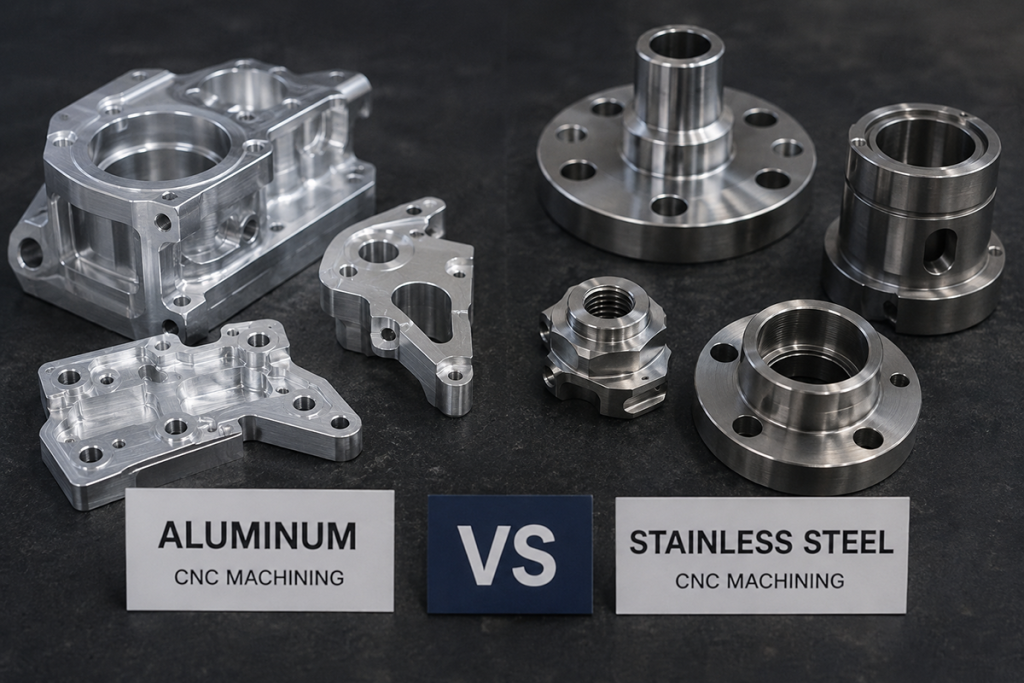
Aluminum is one of the most common materials for robot brackets, arm plates, housings, adapter plates, and lightweight structural parts. It machines efficiently, reduces weight, and supports finishes such as anodizing and bead blasting. For many robotics applications, aluminum CNC machining provides the best balance of strength, weight, cost, and lead time.
Stainless steel may be used when strength, wear resistance, or corrosion resistance is more important than weight reduction. It can be suitable for shafts, pins, fixtures, guide-related components, or parts exposed to moisture or cleaning agents. However, it is heavier and more expensive to machine than aluminum.
Engineering plastics are useful for low-friction pads, gripper contact surfaces, guides, insulators, rollers, and lightweight non-metallic parts. Plastic CNC machining can support POM, Delrin, nylon, PTFE, PEEK, UHMW-PE, and other materials when insulation, low friction, noise reduction, or chemical resistance is needed.
Titanium may be used for high-performance lightweight parts, but it is usually reserved for applications where aluminum is not strong enough and stainless steel is too heavy. Brass can be used for small precision fittings, conductive parts, or threaded inserts. Buyers should compare CNC machining materials based on load, motion, environment, weight, wear, finish, and cost before choosing a material.
Prototype and Low-Volume Robotics CNC Machining
Robotics development often involves design changes. A bracket may need a different hole pattern after assembly testing. A gripper jaw may need a modified contact profile. A sensor mount may need a small angle adjustment after calibration. CNC machining is useful in these situations because it does not require mold tooling and can respond quickly to design updates.
For prototypes, CNC machined parts allow engineers to test real materials, real mounting interfaces, and real mechanical performance. This is more useful than relying only on 3D printed models when the part must handle load, maintain accuracy, or support repeated motion. CNC machining can also produce parts with better material strength and surface quality than many prototype printing methods.
Low-volume robotics CNC parts are also common for custom automation equipment, pilot systems, lab robots, end-of-arm tooling, and specialized production fixtures. Many robotics projects never require mass production quantities. In these cases, CNC machining can remain the most practical manufacturing method even after the design is validated.
For buyers comparing prototype and production planning, CNC machining for prototypes vs production can help determine when CNC is suitable for early testing, bridge production, and repeat low-volume builds.
Surface Finish and Post-Processing Requirements
Surface finish affects robotics parts in several ways. It can influence wear, friction, corrosion resistance, appearance, cable safety, cleaning, and assembly behavior. The right finish depends on the material and the part function.
Aluminum robotics parts may use anodizing, bead blasting, powder coating, or chemical conversion coating. Anodizing is common because it improves surface durability, appearance, and corrosion resistance while keeping the part lightweight. Black anodized aluminum is often used for robot brackets, sensor mounts, and equipment components where appearance and surface protection both matter.
Steel parts may require black oxide, zinc plating, nickel plating, or heat treatment depending on strength and corrosion requirements. Stainless steel parts may use passivation, polishing, or bead blasting. Plastic parts usually do not need coating, but they may require deburring, edge smoothing, or controlled surface finish on contact areas.
Buyers should define which surfaces need special finish and which can remain standard machined. A visible outer surface may require better appearance, while hidden mounting faces may only need functional machining. Surface treatment can also affect dimensions, so critical fits should be reviewed before finishing is specified.
Quality Control for Robotics CNC Components
Quality control is essential for robotics components because small deviations can affect motion, calibration, and assembly repeatability. Inspection should focus on the features that control function rather than treating every surface with the same level of importance.
A good quality plan starts with drawing review. Critical holes, bearing fits, dowel pin locations, mating faces, threads, flatness, and alignment features should be identified before machining begins. If the drawing does not clearly mark these features, the supplier may not know which dimensions need extra control.
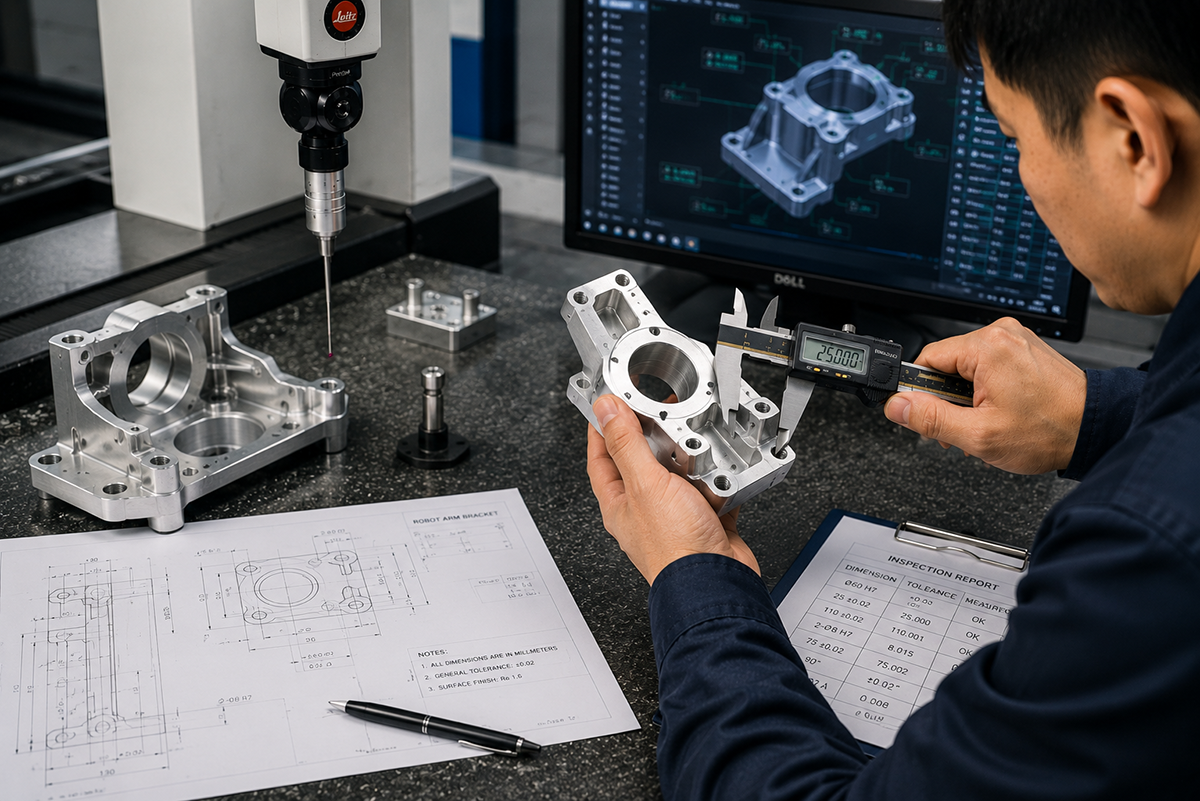
Inspection methods may include calipers, micrometers, pin gauges, thread gauges, height gauges, CMM inspection, surface roughness checks, and visual edge inspection. For parts that affect robot motion or calibration, first article inspection can confirm that the process is stable before producing the full batch.
Batch consistency is especially important for robotics. If ten gripper jaws, brackets, or sensor mounts are used across multiple robot units, they should assemble the same way. Consistent parts reduce adjustment time, improve maintenance, and support reliable equipment operation.
Cost Factors in Robotics CNC Machining
Cost in robotics CNC machining depends on material, geometry, tolerance requirements, finishing, inspection, quantity, and lead time. Robotics parts often include lightweight pockets, multiple holes, thin walls, complex profiles, and precise mounting features. These details can increase machining time if they are not designed with manufacturability in mind.
Material choice is a major cost factor. Aluminum is usually more economical for lightweight structural parts. Stainless steel costs more to machine but may be necessary for strength or wear resistance. Engineering plastics vary widely in cost; POM and nylon are usually more economical, while PEEK can be much more expensive.
Tolerances also affect price. Applying tight tolerances to every surface increases machining and inspection time. Buyers can control cost by marking only critical features with strict tolerances and allowing standard tolerances on non-functional profiles.
Surface finish, coating, and inspection requirements can also add cost. Anodizing, polishing, passivation, coating, CMM reports, material certificates, and full dimensional reports should be specified only when required by the application. For broader pricing guidance, CNC machining cost factors explains how material, tolerance, geometry, finish, quantity, and lead time affect custom part quotes.
What Buyers Should Prepare Before Requesting a Quote
A complete RFQ helps suppliers quote robotics components accurately and provide useful engineering feedback. Buyers should provide 3D CAD files and 2D drawings whenever possible. The CAD file helps with geometry and toolpath review, while the drawing defines tolerances, material, surface finish, threads, critical dimensions, and inspection requirements.
The RFQ should explain the robot application. A supplier can make better recommendations when they know whether the part is used for a robot arm, gripper, sensor mount, fixture, guide, bracket, end effector, or replacement component. Load, motion, vibration, speed, temperature, cleaning exposure, and operating environment can all affect material and finish decisions.
Buyers should identify critical features, including bearing seats, dowel holes, threaded holes, mounting faces, gripper contact surfaces, shaft fits, alignment holes, and dimensions that affect calibration or movement. Non-critical dimensions can usually use standard tolerances to control cost.
If material selection is uncertain, reviewing how to choose CNC machining materials can help define strength, weight, friction, corrosion, wear, and cost priorities before quotation. Buyers should also state whether material alternatives or DFM suggestions are acceptable.
Conclusion
CNC parts for robotics require more than accurate shape. They must support precision, repeatability, stable assembly, controlled movement, and reliable long-term performance. A small error in hole position, flatness, bearing fit, thread quality, or mating surface geometry can affect calibration, gripping accuracy, vibration, wear, and robot reliability.
CNC machining is well suited for robotics because it supports prototypes, low-volume production, custom automation equipment, replacement parts, and functional testing without mold tooling. It also allows buyers to choose materials based on weight, strength, friction, corrosion resistance, conductivity, or wear performance.
The best results come from clear drawings, practical tolerance planning, suitable material selection, defined surface finish, and focused inspection of critical features. Buyers can reduce unnecessary cost by separating functional dimensions from non-critical surfaces, avoiding over-tight tolerances, and allowing supplier DFM feedback before production.
If your project requires robot arm brackets, gripper jaws, sensor mounts, adapter plates, end-effector components, or custom automation parts, our team can review your drawings and recommend practical CNC machining options based on material, tolerance, quantity, finish, and application requirements.