Introduction
CNC machining in aerospace applications is used when parts require high precision, low weight, stable material performance, and reliable quality across prototypes or low-volume production. Aerospace components are often exposed to demanding design requirements where small dimensional errors, excess weight, poor surface finish, or material mismatch can affect assembly, testing, or long-term performance.
For buyers in North America, Europe, and other overseas markets sourcing custom aerospace CNC parts, machining requirements should be defined clearly before quotation. Material grade, tolerance level, wall thickness, surface finish, inspection method, and documentation expectations can all influence manufacturability, cost, and delivery time. A simple-looking bracket or housing may become much more complex if it includes thin walls, tight hole positions, lightweight pockets, or critical mating faces.
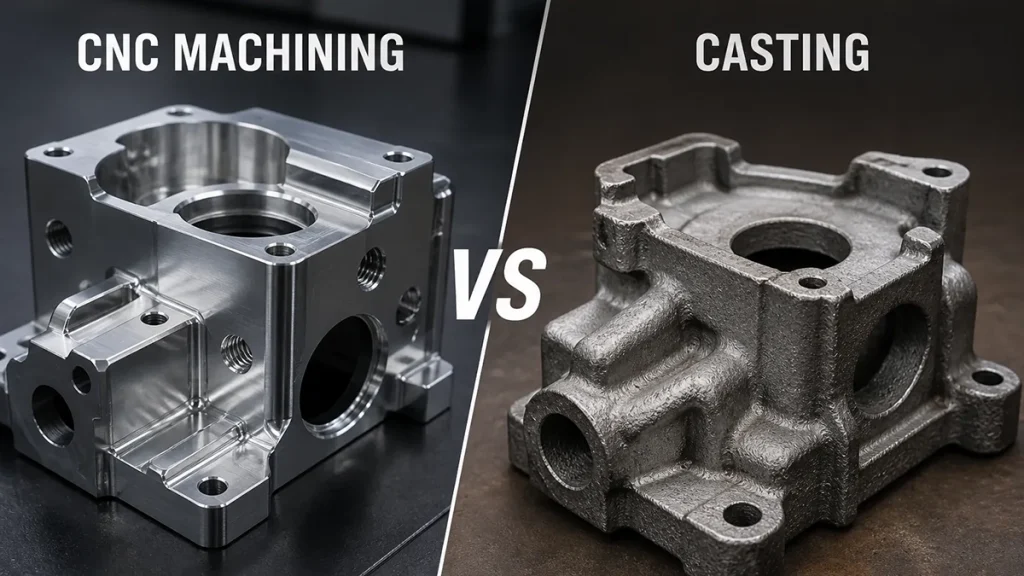
CNC machining is widely used in aerospace-related projects because it supports functional prototypes, low-volume production, test fixtures, UAV parts, drone components, sensor mounts, avionics housings, adapter plates, and lightweight structural fittings without requiring dedicated molds or tooling. This flexibility is valuable when designs are still being validated or when production quantities are not high enough for casting, forging, or other tooling-based processes.
This guide explains how CNC machining supports aerospace applications, which components are commonly machined, what precision requirements matter, how material selection affects performance, what drives cost, and what buyers should prepare before requesting a quote. If your project requires custom brackets, UAV parts, housings, test fixtures, or lightweight precision components, experienced custom CNC machining services can help review your design before production.
Why CNC Machining Is Used in Aerospace Applications
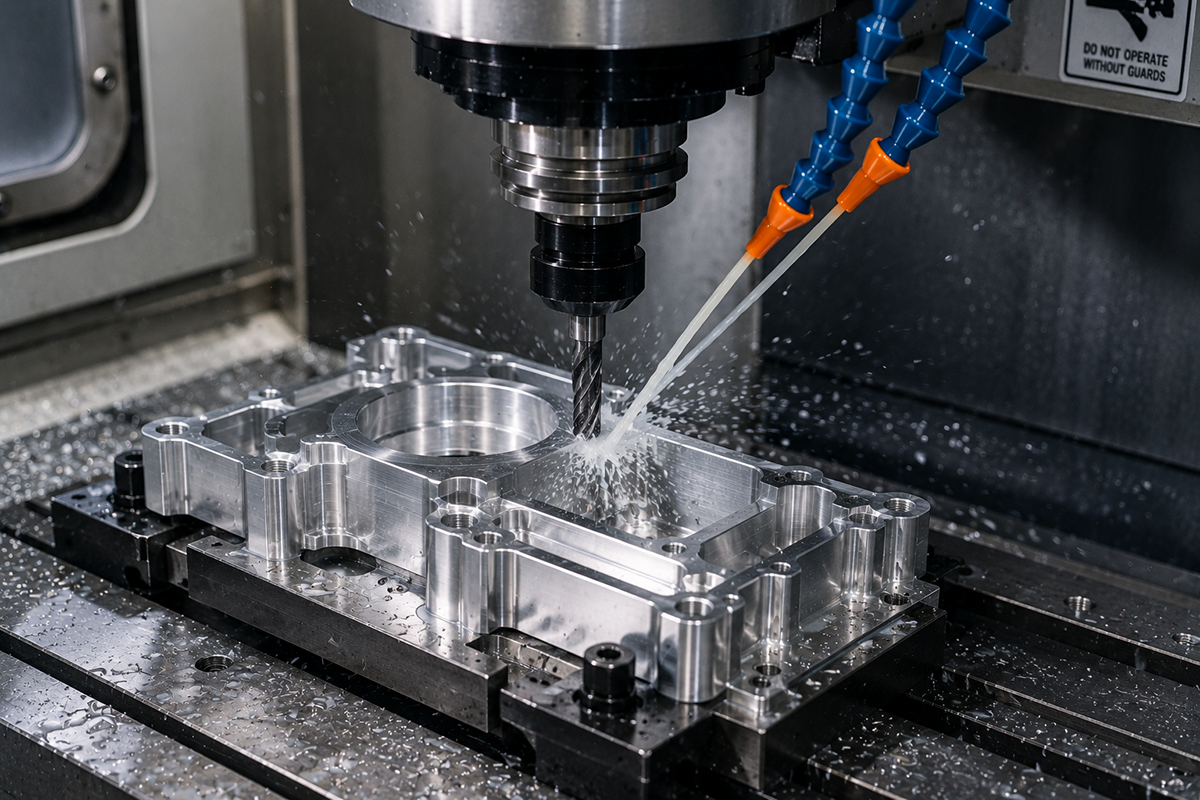
Aerospace projects often require parts that combine light weight, strength, accurate geometry, and stable performance. CNC machining is useful because it can produce these functional parts directly from solid material while allowing engineers to control features such as hole position, flatness, pockets, ribs, threads, and mating surfaces.
Unlike tooling-based methods, CNC machining is practical when designs are still changing or when the required quantity is low. This is important for UAV development, satellite equipment, aviation support tools, test fixtures, and prototype assemblies. Engineers can revise a design, update a CAD file, and machine the next version without waiting for expensive tooling changes.
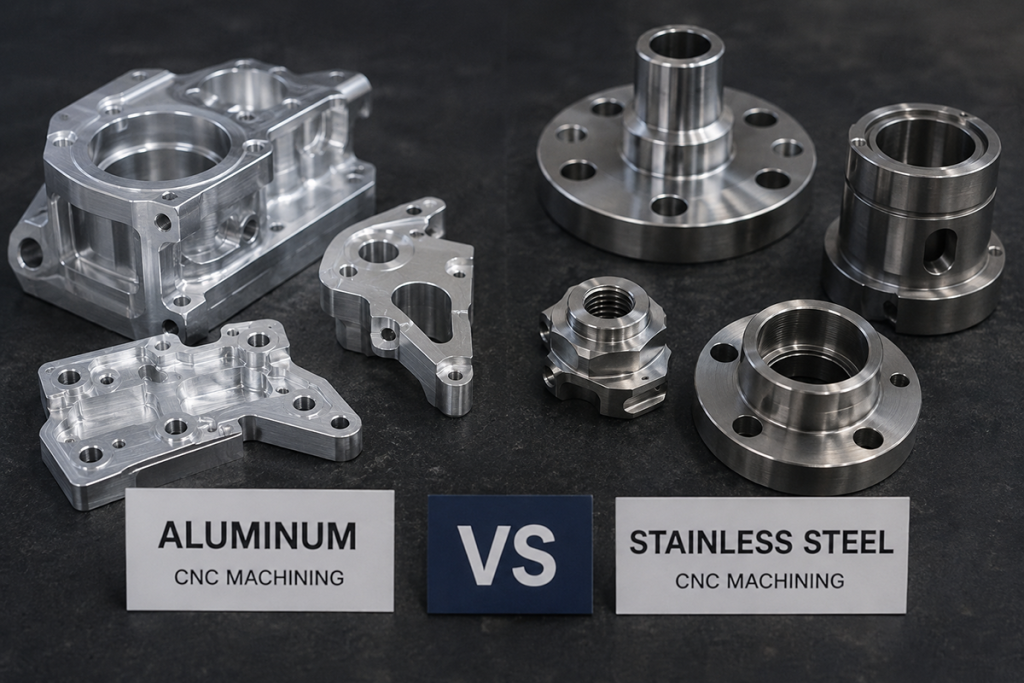
CNC machining also supports a wide range of materials. Aluminum alloys, titanium, stainless steel, and engineering plastics can all be machined for different aerospace-related functions. This flexibility helps buyers compare strength, weight, corrosion resistance, cost, and finish requirements before committing to a final production approach.
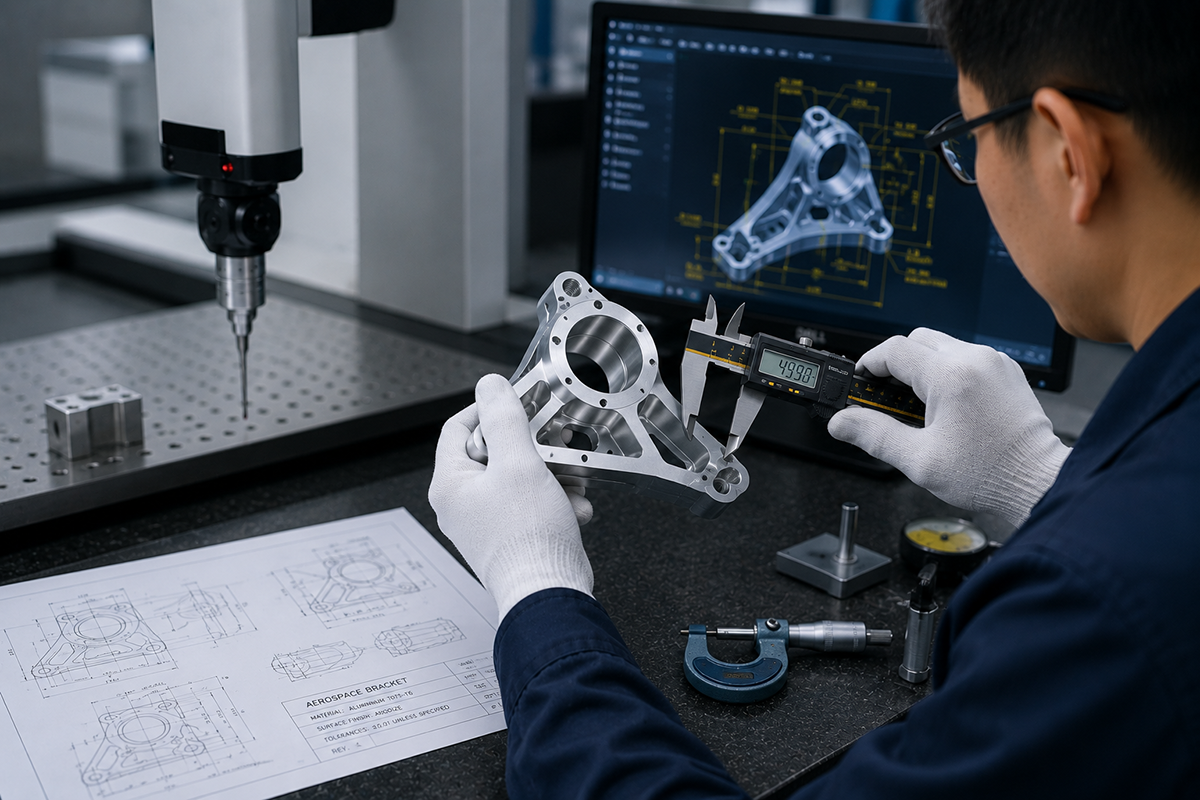
For high-value aerospace components, machining also allows controlled inspection. Critical dimensions can be checked by calipers, micrometers, thread gauges, CMM inspection, or surface roughness measurement depending on the part requirements. This makes CNC machining suitable for projects where quality control is part of the buying decision, not just an afterthought.
Common Aerospace Components Made by CNC Machining
CNC machining is used for many aerospace-related components, especially when the part has complex geometry, low-volume demand, or strict assembly requirements. Common examples include lightweight brackets, mounting plates, adapter plates, UAV frames, drone housings, sensor mounts, avionics enclosures, heat sinks, structural fittings, test fixtures, and prototype components.
Brackets and mounting plates are among the most common CNC machined aerospace parts. They may look simple, but hole position, flatness, wall thickness, and edge quality can affect assembly and load distribution. If the part supports sensors, electronics, or structural connections, accuracy becomes more important than appearance alone.
UAV and drone components are also strong candidates for CNC machining. These parts often require lightweight aluminum structures, thin pockets, precise fastening points, and clean surface finishes. CNC machining allows fast design changes during testing and helps teams validate strength, weight, and assembly fit before scaling production.
Test fixtures and support tooling are another important category. Aerospace development often requires custom fixtures for inspection, assembly, positioning, or testing. These components may not fly on the final product, but they still require accuracy and durability because they support repeatable production or validation work.
Precision Requirements for Aerospace CNC Parts
Precision requirements in aerospace CNC parts should be defined by function. Not every surface needs a tight tolerance, but critical features must be identified clearly on the drawing. Hole position, flatness, parallelism, perpendicularity, bearing fits, thread accuracy, surface finish, and alignment features can all affect how the part performs in assembly.
Hole position is especially important when a component connects to other structures. A small shift in mounting holes can create assembly stress, misalignment, or rework. If multiple parts must assemble across batches, consistent hole locations are just as important as the accuracy of a single part.
Flatness and parallelism matter when surfaces must seat against frames, housings, fixtures, or sensor assemblies. Poor flatness can create gaps, uneven load transfer, or alignment problems. Thin aerospace parts may require special attention because material can move during machining if wall thickness, clamping, or toolpaths are not controlled.
For more complex drawings, geometric controls such as flatness, perpendicularity, parallelism, and concentricity may follow geometric dimensioning and tolerancing principles, especially when the component must align with shafts, bearings, mounting faces, or precision assemblies.
Material Selection for Aerospace CNC Machining
Material selection strongly affects the performance and cost of aerospace CNC machining. The best material depends on strength, weight, corrosion resistance, machinability, temperature exposure, surface finish, and inspection requirements. Choosing a premium material without a clear need can increase cost, while choosing a lower-cost material for a demanding application can create reliability problems.
Aluminum is widely used for aerospace-related prototypes, brackets, housings, plates, and lightweight structures. Grades such as 6061 and 7075 are common because they offer good strength-to-weight performance and efficient machinability. For projects where weight reduction and fast machining matter, aluminum CNC machining is often the first material option to evaluate.
Titanium is selected when high strength, low weight, corrosion resistance, or demanding service conditions justify the added cost. It is more difficult to machine than aluminum, but it can be valuable for high-performance structural components, fittings, and parts where stainless steel would be too heavy. Buyers evaluating high-strength lightweight materials can also review titanium CNC machining before finalizing the material.
Stainless steel may be used for parts that need strength, durability, or corrosion resistance where weight is less critical. Engineering plastics may be used for insulation, lightweight fixtures, guides, non-metallic supports, or prototype features. Buyers should compare material options through CNC machining materials before locking the design.
Lightweight Design and Thin-Wall Machining Challenges
Aerospace components often use lightweight design features such as pockets, ribs, thin walls, and material relief areas. These features reduce weight, but they can make CNC machining more difficult. Thin sections may deflect during cutting, deep pockets may require longer tools, and lightweight structures may be sensitive to vibration or clamping pressure.
The challenge is to reduce weight without making the part unstable to machine or weak in use. A thin-wall part may meet the weight target but become expensive if it requires special fixturing, slow machining, staged roughing and finishing, or additional inspection. A design that saves a small amount of weight may not be worthwhile if it creates major manufacturing risk.
Good design for aerospace CNC parts balances weight, stiffness, tool access, and tolerance needs. Larger internal radii, reasonable wall thickness, accessible features, and clear tolerance zones can improve manufacturability. If lightweight pockets are required, buyers should identify which walls and surfaces are function-critical so the supplier can plan the machining sequence correctly.
Early DFM review is useful because small design adjustments can reduce machining cost without affecting the part’s main purpose. This is especially important for UAV frames, thin housings, sensor mounts, and lightweight brackets where geometry and material removal strategy directly affect accuracy.
Prototype and Low-Volume Aerospace CNC Machining
CNC machining is well suited for aerospace prototypes and low-volume parts because it does not require dedicated molds or dies. This allows design teams to test real materials, verify fit, adjust geometry, and validate functional performance before deciding whether a design is ready for larger production.
Aerospace prototype machining is common for UAV parts, drone housings, avionics brackets, satellite equipment components, test fixtures, and lightweight experimental assemblies. These parts often need to be functional, not just visual. CNC machining allows engineers to evaluate real material behavior, thread quality, assembly fit, finish, and dimensional stability.
Low-volume aerospace CNC machining is useful when the project requires only a small number of parts, custom equipment, replacement components, or specialized test hardware. In these cases, tooling-based production may not be economical. CNC machining provides a practical path from concept to test-ready parts.
If a project is moving from prototype to repeat production, buyers should consider inspection consistency, material availability, and batch-to-batch repeatability. The article on CNC machining for prototypes vs production can help compare early-stage validation and production planning.
Surface Finish and Post-Processing for Aerospace Parts
Surface finish is important in aerospace CNC parts because it can affect corrosion resistance, wear, assembly, sealing, appearance, and long-term reliability. The right finish depends on the material and application. A raw machined aluminum bracket may be acceptable for testing, while a production component may require anodizing, hard anodizing, chemical conversion coating, bead blasting, passivation, or polishing.
Aluminum parts are often anodized or hard anodized to improve corrosion resistance and surface durability. Chemical conversion coating may be used when corrosion protection and electrical conductivity are both considerations. Stainless steel parts may require passivation or polishing. Titanium parts may need controlled surface finishing depending on the application.
Finish requirements should be defined before quoting because they can affect dimensions, cost, and lead time. If a surface is used for assembly or sealing, the drawing should state whether dimensions apply before or after finishing. If a surface is cosmetic only, buyers should identify which areas are visible and which can remain standard machined.
Post-processing can improve performance, but unnecessary finishing adds cost. The most practical approach is to define the function of each finish: corrosion protection, wear resistance, appearance, insulation, or assembly compatibility. This helps the supplier quote the correct process and avoid over-processing non-critical surfaces.
Quality Control and Inspection Requirements
Quality control for aerospace CNC machined parts starts before machining begins. The supplier should review drawings, material requirements, tolerance zones, critical surfaces, thread notes, finish requirements, and inspection expectations. Clear drawings reduce assumptions and help avoid costly rework.
Inspection may include calipers, micrometers, pin gauges, thread gauges, height gauges, CMM inspection, surface roughness checks, and visual inspection depending on the part. For precision aerospace components, critical dimensions should be identified rather than applying strict inspection to every feature.
Material documentation and traceability may be important for certain aerospace-related projects. Buyers should state whether material certificates, inspection reports, first article inspection, or batch records are required. However, suppliers should not claim aerospace certification unless that capability is real and documented. For many prototype or non-flight aerospace support parts, practical inspection and material verification may be sufficient.
Batch consistency also matters. If ten brackets are used in one assembly, all ten must fit the same way. Repeatable machining, controlled tooling, stable workholding, and consistent inspection help ensure that parts do not vary from batch to batch.
Cost Factors in Aerospace CNC Machining
Cost in aerospace CNC machining is affected by material, geometry, tolerance, surface finish, inspection, quantity, lead time, and documentation needs. Aerospace-related parts often cost more than general industrial parts because lightweight features, thin walls, tight holes, and special finishes require more process planning.
Material can be a major cost driver. Aluminum is usually more economical than titanium, while titanium may justify its cost when weight, strength, and corrosion resistance are critical. Stainless steel may be cost-effective for durable components where weight is less important. Engineering plastics may reduce weight or provide insulation, but high-performance plastics can also be expensive.
Geometry is another major factor. Deep pockets, thin walls, complex 3D contours, small tools, tight internal radii, and multiple setups increase machining time. If these features are functional, they may be necessary. If they are not critical, simplifying them can reduce cost without reducing part performance.
Tolerance and inspection requirements also affect price. Tight tolerances should be applied only where they are function-critical. CMM reports, material certificates, first article inspection, and special finishing add value when needed, but they should be requested clearly. For broader pricing guidance, buyers can review CNC machining cost factors before preparing an RFQ.
What Buyers Should Prepare Before Requesting a Quote
A complete RFQ helps the supplier understand the aerospace application and quote accurately. Buyers should provide 3D CAD files and 2D drawings whenever possible. The CAD file helps review geometry and tool access, while the drawing defines material, tolerances, threads, surface finish, inspection notes, and documentation requirements.
The RFQ should also explain the application. Is the part for a UAV, drone, avionics enclosure, test fixture, bracket, structural fitting, or support tooling? Will it be exposed to vibration, temperature change, moisture, corrosion, or repeated assembly? These details help determine whether the selected material, finish, and tolerance level are appropriate.
Buyers should identify critical features such as mounting holes, bearing seats, mating faces, sealing surfaces, thin walls, threaded holes, and alignment features. If no special tolerance is required, general tolerances can be used for non-critical surfaces while tighter requirements are marked only where function demands them.
If material selection is uncertain, buyers should state whether alternatives are acceptable. A supplier may recommend aluminum instead of titanium for a prototype, 7075 instead of 6061 for higher strength, or stainless steel when corrosion and durability are more important than weight. Reviewing how to choose CNC machining materials can help buyers define strength, weight, corrosion, and cost priorities before quotation.
Conclusion
CNC machining in aerospace applications is valuable because it supports precise, lightweight, functional parts without requiring dedicated tooling. It is especially useful for prototypes, UAV components, drone parts, avionics housings, sensor mounts, lightweight brackets, test fixtures, and low-volume aerospace-related components.
The success of an aerospace CNC project depends on more than producing the correct shape. Material selection, thin-wall stability, tolerance planning, surface finish, inspection, and documentation all affect performance and cost. Aluminum, titanium, stainless steel, and engineering plastics can each be suitable when their properties match the part’s function.
Buyers can improve results by preparing complete RFQ information, identifying critical dimensions, defining surface finish requirements, and allowing supplier feedback before production. Realistic tolerances and clear application details help reduce unnecessary cost while protecting the features that truly affect performance.
If you are developing aerospace-related CNC machined parts and need support with material selection, tolerance feasibility, lightweight geometry, finish requirements, or cost control, our team can review your drawings and recommend a practical machining approach based on your application, quantity, and quality requirements.